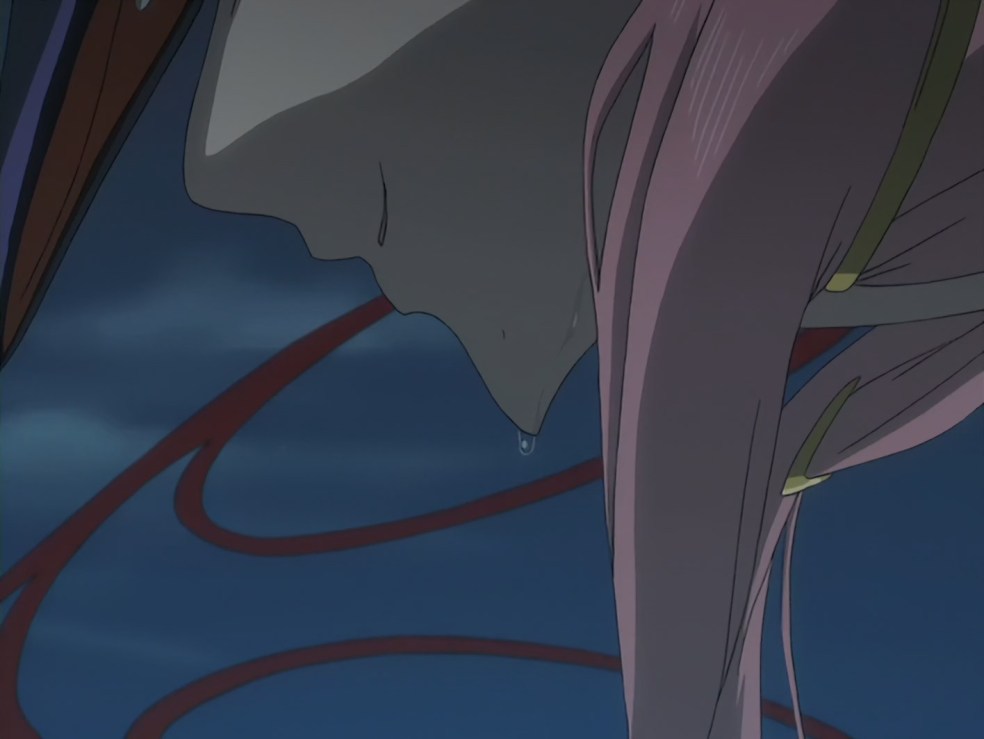
Twenty Perfect Minutes: Eureka Seven Episode 48 – Ballet Mechanique

Twenty Perfect Minutes is an irregular column series where I take a look at single specific anime that shaped my experience with the medium, were important to me in some other way, or that I just really, really like. These columns contain spoilers.


I’ll tie up my hair, swaying in the wind, take one giant leap onto the earth, and then hold my head up high and go see him.

Eureka Seven is a series that deals with big ideas and has a large cast. But for nearly all of its 50 episodes, the story remains centered on Renton Thurston and the titular Eureka, with tangents and leaps over to other characters being generally tied to one or the other in some way. This makes sense, it gives the anime a solid grounding and provides a foundation on which to build up those big ideas. It is completely and totally understandable that Eureka Seven, at its core, is the story of Renton and Eureka.

Except, of course, when it’s not. Arguably, the single best episode of the anime, and the one that embodies some of those big ideas the best, is one of the few that isn’t really about either of those characters.

For about twenty-four minutes, Eureka Seven ceases to be the story of Renton and Eureka, and becomes the story of Anemone and Dominic. A girl who has hidden herself for so long that she’s forced herself to forget how to smile, and a young man so desperate to right the wrong he’s committed by not telling her how he feels that he’ll go to any lengths to finally do it. One of Dewey Novac’s surgically-altered child soldiers, and someone who used to believe in the man. “Ballet Mechanique” does not, as some similar episodes in other anime do, turn Eureka Seven into a different show, because the themes and emotional core remain the same. But it is a fascinating, heart-rending, but ultimately, uplifting look at what the series is like through different eyes.

“Ballet Mechanique” opens, after some basic scene-setting, with Anemone, deployed on what looks to be a suicide mission, and her internal monologue.

It’s faux-casual. Anemone lists her regrets; she’d like to go shopping more, she wants to try different foods. And of course, tossed in with a careful, pained fake-indifference, she would just love to have a real romance. Certainly, she seems to imply, there is no way a certain lieutenant who she at this point believes has abandoned her is at all on her mind. She tries to downplay her own heartbreak. The defense mechanism of someone who has never been allowed to express pain.

By this point in the series, anyone watching blind (a category I myself was in) is holding their breath. Eureka Seven is an anime with several emotional peaks and valleys, and there is a long stretch in the middle of the series where it seems like things are going to go very badly indeed. By “Ballet Mechanique”, the tone has been more hopeful for some time, but at least for me, there was a lingering thought in the back of my mind that I was hearing a teenage soldier’s last thoughts before her tragic demise.

As she moves out, alone with only her LFO (the theatrically-named Type the:END) to keep her company, the façade rapidly starts to crack. She starts to wish that she had told Dominic how she felt when she still had the time, and that when she dies (tacitly accepting it as inevitable) that she’s reborn as someone smarter.

Meanwhile, the moment Dominic learns that Anemone is involved, he springs into action. Dominic is not normally that sort of character by any means–he’s not even an LFO pilot–so it takes real guts for him to hijack one of the Izumo’s escape pods to intercept the:END himself. He even balks at Holland’s attempt to get him to turn back.

Eureka and Renton’s involvement in “Ballet Mechanique” centers around their initial interception of Anemone. This being the rare episode where they’re more supporting characters than the main focus. They first fight, and then attempt to save, Anemone when the Nirvash’s drive (a literal empathy machine) makes it clear to them that she can be. But, it’s key to note, Renton and Eureka cannot, and do not, save Anemone.

That is up to Dominic. He arrives, falling from the sky and screaming his heart out. The episode’s climax is a tangle of shouted emotion and pained declarations of love. Anemone and Dominic kiss while falling through the air, a piece of imagery Eureka Seven had a notable fascination with and that it would repeat two episodes later in its finale.

Even the:END gets a brief turn here, as he’s “purified” by Anemone’s change of heart, only to die minutes later when he protects her and Dominic from Dewey’s orbital cannon.

Eureka Seven is a messy series, and it’s one that, despite being very strong overall, has few single standout episodes, since they tend to rather immediately flow from one to the next.

Even “Ballet Mechanique”, I must admit, became just a touch harder to follow among some of the finer points upon my revisiting the episode nearly a year later to finish this article. (I don’t really remember what that laser cannon was about. Do you?) But still, it remains one of the show’s strongest cases for its core theme of love as a salve to the world’s many evils. Plus, if I can admit my own bias, it’s an incredibly cathartic end to the character arc of Anemone, who was and remains my single favorite character from the series.

At Eureka Seven‘s end, she and Dominic stand as the title couple take center stage. They lock hands the entire time, quieter than the leads, but no less in love.

“I once was lost
but now am found
was blind,
but now I see”


Wanna talk to other Magic Planet Anime readers? Consider joining my Discord server! Also consider following me on Twitter, supporting me on Ko-Fi, or checking out my other anime-related work on Anilist or for The Geek Girl Authority.

All views expressed on Magic Planet Anime are solely my own opinions and conclusions and should not be taken to reflect the opinions of any other persons, groups, or organizations. All text is owned by Magic Planet Anime. Do not duplicate without permission. All images are owned by their original copyright holders.
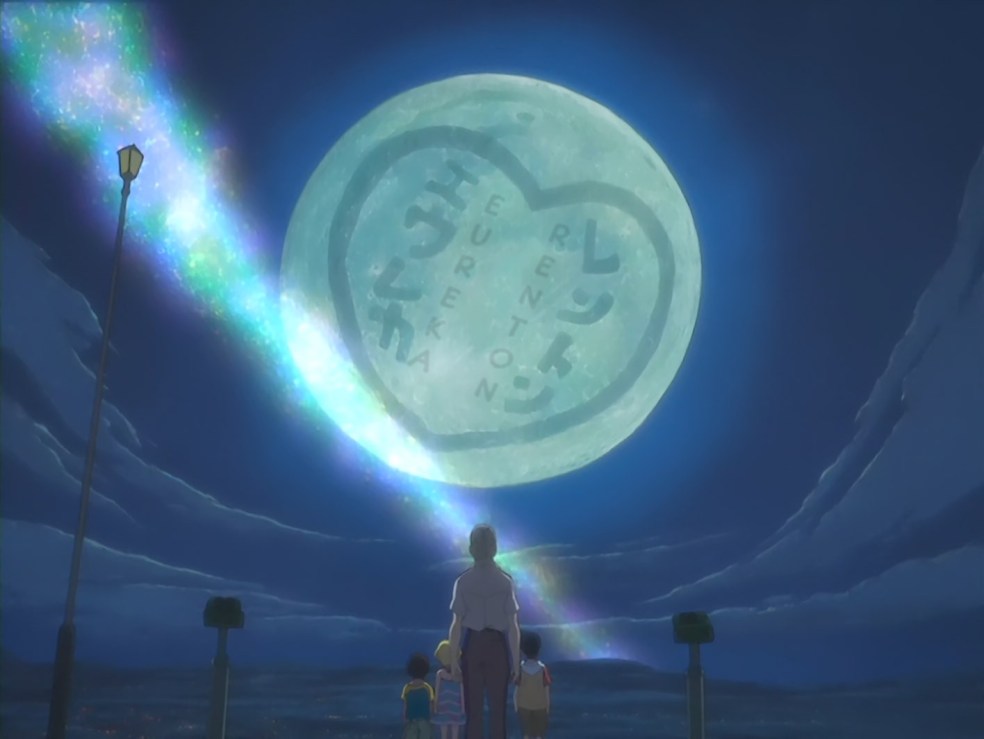
Weekly Writing Roundup – 9/20/20

Hi folks! Bit of a lighter week this time around, I’ve been in a rough spot mentally and I’m sure I’m not the only one, given yet more recent goings-on in the world. But I won’t get too into that here, this isn’t really that kind of blog. Take care of each other out there!

On to the roundup!

The Geek Girl Authority

THE GOD OF HIGH SCHOOL Recap (S1E11) lay/key – I don’t like being this blunt, but man I have just not been impressed with this show recently. I’m not sure if it’s actually gotten any worse (in fact I don’t think it has) but its tendency to seriously abbreviate character arcs has started getting on my nerves. Pacing problems like this are pretty common in the modern TV anime landscape since almost everything only gets a single cour at a time, but GOH really feels like it could’ve used another cour to really stretch its legs. The fights are still cool at least, although I wish they lasted longer.

Didn’t do a Deca-Dence recap this past week for Reasons. I’m gonna roll the final two episodes into a single recap this coming Wednesday, assuming everything goes according to plan.

Magic Planet Anime

(REVIEW) Love in Wartime: The Politics & Emotion of EUREKA SEVEN – Without blowing my own horn too much, I think this is one of the best things I’ve ever written for the site and possibly just in general. I absolutely loved Eureka Seven by its end and I hope I can inspire at least one more person to watch it. (The minder of fellow anime blog Crow’s Anime World mentioned they want to watch it, so it’s possible I’ve succeeded!) I only finished Eureka Seven a week ago but it already feels like a part of me, it’s really something special.

Full disclosure, this week was also supposed to see the triumphant return of the Twenty Perfect Minutes column, regarding this series’ 48th episode (one of my favorites in anything ever, full stop) but once again mental health got in the way. Maybe next time!

Twitter “Live Watches”

Revolutionary Girl Utena – I’m going through Utena at a pretty slow pace and I think these episodes are a good indicator of why. I love the show, don’t get me wrong, but parts of it are some of the most actively draining television I’ve ever watched. I feel absolutely terrible for….everyone involved, and we’re not even at what is, to my understanding, The Worst Part yet. Ten episodes (and a movie!) to go.

Sailor Moon – SAILOR MERCURY AAAAAAAAAAAAAAAAAAAAAAAAAAA. Yeah I don’t have a ton to say on this week’s Sailor Moon I love Ami. She’s great.

We’re getting near enough to the end of Utena that I’m starting to contemplate what I should start the next livewatch on after we’re done with it. Magical Girl Lyrical Nanoha maybe?

Other Thoughts N Such

I was recently commissioned to watch Mao Mao: Heroes of Pure Heart. It’s a bit unusual for this blog since it’s an American cartoon. I don’t entirely know how I feel about it, being only a couple episodes in. It’s very….frantic, which feels like the logical consequence of a series for a generation raised on Teen Titans Go. (Watching this series makes me feel kinda old lol). We’re still well off from the proper review, so there’s plenty of time for my opinions to change. I like Adorabat, she’s funny.

On an administrative note. I’ve FINALLY updated my Carrd page after not doing it for the longest time. The biggest point of interest to blog-readers is going to be my commission page. Consider sending me some money to watch your favorite series, film, or OVA!

That’s all for this week! See you around folks.

If you like my work, consider following me on Twitter, supporting me on Ko-Fi, or checking out my other anime-related work on Anilist or for The Geek Girl Authority.

All views expressed on Magic Planet Anime are solely my own opinions and conclusions and should not be taken to reflect the opinions of any other persons, groups, or organizations. All text is owned by Magic Planet Anime. Do not duplicate without permission. All images are owned by their original copyright holders.

(REVIEW) Love in Wartime: The Politics and Emotion of EUREKA SEVEN

This review was commissioned. That means I was paid to watch and review the series in question. You can learn about my commission policies and how to buy commissions of your own here.

This review contains spoilers for the reviewed material. This is your only warning.


Amazing grace
how sweet the sound

Sekai-kei, or “world story”, is a term of disputed origin. Held by many to be a westernism, invented by bloggers searching for a term to describe Neon Genesis Evangelion and stories of its ilk. Stories where the fate of the universe is tied inextricably to that of a central relationship and the mental state of its lead characters. NGE may hold the title as the series that inspired the term, but no anime has ever worn it as well as Eureka Seven. And no matter its origin, more than many anime the phrase is used to describe, “world story” feels like it fits Eureka Seven like a glove. Fifteen years after it began airing, E7 is capable of an astounding thematic and emotional resonance that hits as hard in 2020 as it did when the series ended in 2006. It’s matched by little else.

Try to grab hold of it, and it breaks down into images. Blood on wedding rings, underground rainbows, Superflat monsters and sky-fish, mecha on surfboards, political intrigue, social upheaval. Love, war, death and more, all soundtracked to trance, house, pop, and soul. This is Eureka Seven. Wildly ambitious, flawed but magnificent. Riddled with paradoxes, it is gangly and perfect.

It’s not hard to understand E7’s methodology. It combines an older, political strain of mecha anime with the metaphysical, psychological approach of the NGE* era. In this way, its closest contemporary cousin, funnily enough, might be another ambitious mecha series of the same era that attempted a similar approach; Code Geass. But while that anime traffics chiefly in camp, the minutiae of revolution, and shock value, Eureka Seven deals in much simpler, more universal substance. As promised in the title; emotion, politics, and the messy grey area that is their intersection.

It is again helpful to consider Eureka Seven as a series of meaningful contradictions. It bursts with music, but is punctuated by the shellshocked silence of war trauma. Dozens of opposites run through the show; love, and death, built things and natural things, Wide-eyed romantic idealism and stoic pragmatism, new life and disease, and so on. In this way, despite the fantastical nature of its soft sci-fi setting, Eureka Seven’s world is a lot like our own. This is important, because Eureka Seven is an anime with things to say, even if it takes a little while to get there.

Eureka Seven opens presenting itself as a classic adventure story. That of Renton Thurston, son of the late war hero Adroc Thurston, and his encounter with–and eventual admittance to–‘terrorist’ group The Gekkostate. It never sheds the structure of a latter-day bildungsroman, especially since Renton’s romance with the titular Eureka is a key part of the series, but it does go significantly beyond it in several other ways.

Other coming-of-age stories have dealt with the realities of growing up in a politically tense period. Few have depicted the rise of fascism with such polished, unsettling ease as Eureka Seven. The ascent of the dictatorial Dewey Novac ties to broader political sensibilities throughout the show. It is not a coincidence that Novac’s forces are generally clad in Nazi-evoking black uniforms, while the Gekkostate and affiliated resistance have a wide variety of looks, often inspired by musical subcultures. (The series overflows with musical reference, down to the name of Renton’s father. A namecheck of Beastie Boys member Ad-Rock.) Later, as Novac’s regime seizes power (complete with a by-the-fascist-book “big speech” to accompany his coup in episode 37) he launches a genocidal campaign against the scub coral. And plans involving surgically-altered super soldier children stretch back in-series years.

Elsewhere, the plight of the Coralians and their complex relationship to the humans in the world of Eureka Seven speak to an environmental bent. The series’ use of what is essentially technobabble may seem campy or silly, but it belies an internal logic that maps cleanly onto many different real-world problems. The “Question Limitation” is not something we will ever have to deal with, but similarly ominous two-word phrases (such as say, “Global Warming”) seem quite certain to define our immediate future.

The show’s long, rough middle third, meanwhile, where Renton is first hazed and then downright abused by many different members of The Gekkostate (but especially Holland) is a bleak, raw look at how such cycles of abuse perpetuate. Renton’s own journey to maturity is hamstrung by the existence of three malformed father figures; Adroc, the war hero who was never there for his own son, Holland, who grapples with his own complex feelings of responsibility regarding Eureka and often takes this frustration out on Renton in this portion of the series, and Charles, a loving father like Renton’s never had, but also a bloodlust-driven bounty hunter, whose conflicts with The Gekkostate eventually see him shot dead by Holland. It is only Renton’s ability to rise above all this–and to forgive–that allows these cycles to cease, and for him and Holland (the only one of the three still alive) to move forward.

All of this only scratches the surface, but you get the point. You may ask what ties all of these disparate themes together, and the answer is shockingly simple. One of anime’s great achievements as a medium is the ease and sheer emotional intensity with which it is often capable of portraying the simple, necessary, terrifying joy of human connection. In Eureka Seven, all of these problems, to a one, can be overcome by communication. By mutual understanding. By love. The show’s final opening theme–“Sakura”–interpolating, in a genuinely brilliant compositional move, the hymn “Amazing Grace”, gives the game away. It seems to say; If God lives not above, then we must love each other in his place. We have a duty to see the worth inherent in each other.

Indeed, Eureka Seven‘s greatest achievement is not any great subversion of expectations, any particular cut or shot (though many excellent examples of both exist throughout), its unique soundtrack, or anything else of the sort. It is this emotional core of empathy triumphing above all else that stands out. It is a spirit that persists in the medium to this very day, shining through from time to time in even the least of Eureka Seven‘s successors.

By Eureka Seven‘s end, and the incomparably romantic imagery of Renton and Eureka cradling each other in their arms as they hurdle through the sky, the series has made its point. Fifteen years later, in a world that every day feels closer to falling apart, Eureka Seven‘s message that even in our darkest hours we must hold each other close feels more resonant, immediate, and heartfelt than ever. That it’s so beautifully put together feels like proof that it’s the truth. How sweet, indeed, the sound.


*NGE of course did not invent this particular sort of mecha series, it merely popularized it. I’m inclined to suspect a shared lineage dating back to perhaps Macross. But without having seen that series myself it’s hard to say more, definitively. Eureka Seven is flooded with shared DNA both between and directly from other mecha anime and other sci-fi in general. I spotted more than one point of homage to another Gainax series; Gunbuster, and have been informed of several that draw from sci-fi novels. Director Tomoki Kyoda has called the series an “homage to his rebellious phase”, a sentiment that tracks with its empathetic state of mind and general feel quite wonderfully.

If you like my work, consider following me on Twitter, supporting me on Ko-Fi, or checking out my other anime-related work on Anilist or for The Geek Girl Authority.

All views expressed on Magic Planet Anime are solely my own opinions and conclusions and should not be taken to reflect the opinions of any other persons, groups, or organizations. All text is owned by Magic Planet Anime. Do not duplicate without permission. All images are owned by their original copyright holders.