

The Weekly Orbit is a weekly column collecting and refining my more casual anime- and manga-related thoughts from the previous week. Mostly, these are taken from my tumblr blog, and assume familiarity with the works covered. Be wary of spoilers!
Hello, anime fans! I don’t have much to say this week, so I won’t belabor the point. Let’s get into things.
Anime
Mayonaka Punch – Episode 4
In a development I definitely wouldn’t have predicted even a week ago, the title of “first anime to make me cry this season” goes to Mayonaka Punch.
This is very different in tone, structure, and even subject matter to every prior episode of this show and, judging by the previews, probably many of the later ones, too. Rather than focusing on the main group, this is a spotlight episode about Fu, probably the least-focused-on member of the group so far, and an old friend of hers named Aya. It’s much more poignant and heartbreaking than funny, and I think MayoPan, somewhat surprisingly, manages to make this massive shift in mood completely work.
Before now, the series hasn’t really grappled with what it means to be a vampire. It’s been an obstacle or inconvenience or a role that comes with a set of rules or even a prop for some of Masaki’s videos earlier in the series. With this episode though, MayoPan drills down on one of the oldest tropes in vampire fiction; the tragedy of immortality.
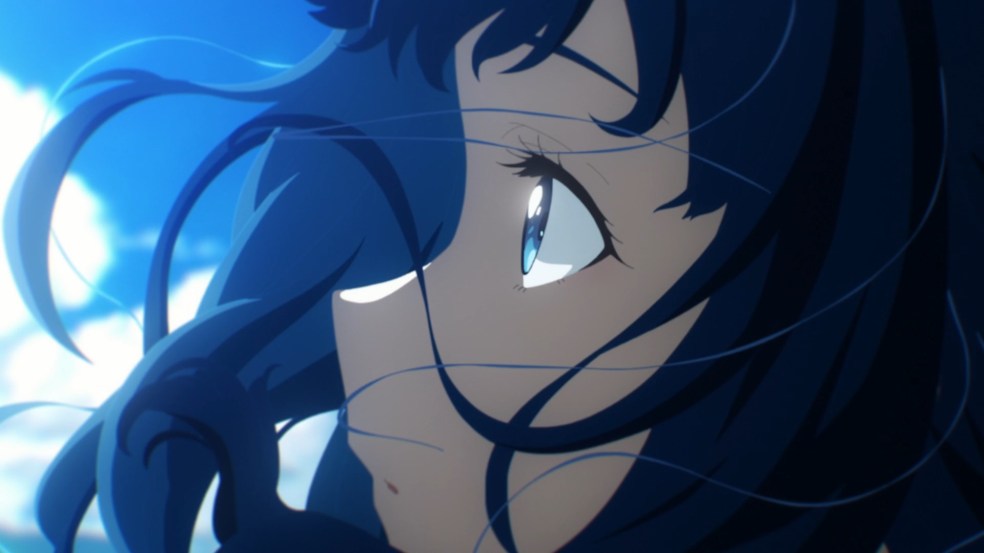
Fu met Aya when the latter was, going by her appearance, roughly a high schooler. She got Fu into western rock and pop music, and the two played music together, with Fu singing and Aya providing guitar. Aya eventually gets the idea that Fu is such a good singer that they could even go pro. Fu knows—and Yuki tells her this much—that this cannot possibly work. She can’t go out in the sunlight and doesn’t age, so people will start talking at some point. The entire thing is a foolish dream, and Fu knows this. But she can’t bring herself to tell Aya, and she ends up stringing Aya along right up until the very moment that they’re supposed to debut as a duo on an outdoor stage. The sun catches her outstretched hand, which briefly alights, and scared and confused, she runs away.
Back in the present, Masaki finds out about all this from the other vampires and gets it in her head that she should record Fu singing covers. Fu is initially very reluctant, but after a somewhat strained heart to heart she ends up seeking Aya out upon learning that she moved to New York some years ago. Then, upon meeting a friend of hers, the episode delivers its solemn last twist; Aya is dead. Fu will never see her friend again.
All of this loses something in the retelling, but in the moment it’s really, truly heartwrenching. (I love Masaki and Fu’s conversation, too. Fu goes back to this idea several times that she doesn’t deserve to sing, since she abandoned her friend, but Masaki contends that there’s nobody who doesn’t deserve to do the things that make them happy. There’s something really powerful in that, and I think it’s a theme the show will come back around to.) Fu makes a kind of peace with Aya’s passing, and the episode has a semi-happy postscript in that she does end up singing for the channel, pouring her passion into a new version of her dream in her friend’s memory, but it’s definitely bittersweet as opposed to just straight-up happy.
With this episode I think Mayonaka Punch has firmly placed itself in roughly the same category as Zombieland Saga, another show about undead entertainers that is fully willing to mine that status for both comedy and pathos. ZLS was, until now, a one-of-one, so I’m really happy to see something picking up its torch in this way. I don’t know if it’ll ever touch this territory again, but I’m glad that it did. Not only does this do an amazing job of making Fu immediately one of my favorite characters, it’s just also a frankly incredible piece of character work top to bottom, a story so self-contained that it’s almost a great anime all on its own.
Wistoria: Wand & Sword – Episode 4
Full credit: giving Will literally any other motivation beyond his vague crush on a character who’s barely on screen is probably a good move, and overall I liked the tavern showdown scene at the end of this episode, since it was the first time in this entire series that it has felt like there’s something riding on anything that’s happening. Also, hey, Wistoria recognizes that racism is bad! The subject is handled pretty poorly and with all of the inherent problems of the “fantasy racism” proxy, but at least it knows it’s bad. That’s something. That’s more than you get from some fantasy anime. Also we have our first actual arc set up now, which is good, too. Maybe I’ll end up liking this show by the time it ends after all! Who can say?

The Elusive Samurai – Episode 5
I was a little worried after last week but we fully bring it back here with a return to properly interesting visuals and a new character to round out the cast. The new guy, the master thief Genba [Yuki Aoi], I quite like him! It’s interesting that he’s something of a foil to Tokiyuki himself and how the series plays that up by having him actually morph into Tokiyuki with his magic mask in the last scene here.
Makeine: Too Many Losing Heroines! – Episode 4

A lovely and lightly meta episode this week. Let’s ask a question, does being a boy prevent Nukumizu, our lead, from being one of the “losing heroines” of the title? I would venture—even setting aside shenanigans from a few episodes back—that it does not. This episode sees him prematurely “dumped” by Anna as the two go through a fairly protracted series of misunderstandings as they more clearly work out what their feelings for each other actually are. Nu-kun clearly likes Anna, and I wouldn’t be that surprised if she liked him too on some level, but things are not lined up at the moment for our leads to get together. So they don’t! They’re just friends instead. At least for now.


In their final rooftop conversation—the second of the series—Anna mentions that as part of the lit club’s whole composition assignment she’s started writing, and that she also likes the books that Komari has recommended her. This is interesting to me because it’s a direct reference to Makeine’s own status a romance novel about romance novels, a romcom that is in part about how romcoms themselves tick. A lot of this episode is actually fairly somber because it’s in the midst of Anna and Nukumizu’s sort-of disassociation from each other after the latter overhears some popular girls talking about how Anna’s out of his league. The show represents this visually by repeating a key shot three times, once during an ordinary day, a second time, during all of these misunderstandings, in the middle of a downpour, and then a third time the day after the rain breaks as summer vacation lurks just around the corner. It’s a great visual trick in an episode full of them.
On that note. I read something earlier today which, to put it mildly, I did not agree with, about how considering an anime’s visuals and story separate is something only people who don’t consider the artform particularly seriously would do. A better and more true way to rephrase that sentiment, I think, would be to say that when the visuals and story work together this well, you tend to not be able to see the seams. I can only imagine how thorough the adapting process must’ve been for this series, it doesn’t seem like it’d be an easy thing to turn a light novel into an anime that’s this visually sumptuous, but Makeine keeps pulling it off.

I haven’t even talked about the whole Komari <-Tamaki-> Koto setup that is resolved in the first part of this episode and is, in some ways, a pre-reflection of what happens with Anna and Nukumizu (and their mutual friend, Anna’s crush Sousuke). It’s really quite astounding how a show that’s so simple at first blush has so many layers to it.
Bye Bye, Earth – Episode 4
As always, Bye Bye, Earth feels more like a highlight reel of its source material than a real adaptation, and as a result the story strains against awkward runs of internal narration and exposition. Nonetheless, because the setting of the series is just that odd, it’s still a compelling watch. This episode is an outpouring of odd, fascinating ideas; flower-cats that the solists test their swords on, question marks as symbols from “the age of the gods” that can render swords inert, a literal battle of the bands that sees our protagonist conscripted into a militarized marching band and sent to the slaughter.
It’s not nonsense; there’s an obvious extension of the theme of finding a place where one belongs, here, but it’s all a bit opaque. I can’t help but wish this had gotten more episodes or even just been adapted at a slower pace so it really had room to breathe. Nonetheless, it’s one of the season’s weirdest, most underrated anime, and I do think it’s worth keeping up with.
Oshi no Ko – Season 2, Episode 5
I don’t know how to explain it but watching this show is legitimately intoxicating. I need more anime where the entire cast are just complete maniacs, man. We don’t have enough of that.
Obviously, at this stage of this season’s plot, tensions are running really high as everyone has a ton of emotional investment in how the Demon’s Blade play does. The way this episode makes you feel that by plunging you into all of this huge spiderweb of entangled neuroses is just the absolute best. Half of the cast completely hate each other! Akane and Kana consider themselves rivals, obviously over Aqua, but arguably more importantly as actresses with wildly diverging styles and with a personal history that goes back to their respective childhoods. They spend so much of this episode openly taunting and seething at each other, it’s great. It is some Grade-A Toxin.

If you told me they were the eventual endgame couple I’d completely believe you. (I’d only even be skeptical because of Akasaka’s generally lacking queer representation in his works.) They genuinely look like they wanna kill each other by the end of the episode, it is the best.

This, too, is yuri.
Melt, who would be a complete nothing of a character in almost any other series, has an amazing scene here where he tries to tell off one of the other actors—who is acting like a complete scumbag, mind—only to be insulted by him because of his poor performance on Sweet Today last season, so he spends the whole episode, appropriately enough, melting under the pressure and angry with himself for lacking talent.
Aqua, of course, is trying to wring a good performance out of himself here because of his own ongoing goals. Aqua has spent a lot of these past two episodes wrestling with his demons (almost literally, given that his past life self is represented as a flickering mass of shadows) but somehow the most “ha ha, yes!” moment of the whole episode to me was him casually dropping to Akane that he plans on murdering someone and her just rolling with it. Does she think he’s just floating a thought experiment? Who knows! Akane is so fucked up that it’s hard to guess! Everyone in this show is so fucked up that it’s hard to guess!

Anime – Non-Seasonal
BanG Dream! It’s MyGO!!!! – Episodes 7 & 8
Speaking of messy, emotionally driven storytelling in a cast full of complete wrecks, hey, remember It’s MyGo!!!! ? One of my favorite anime premieres of last year? Yeah, it feels a little silly to whip out that whole subheader for a fairly short writeup but, hey, one of the anime I really liked from last year that I didn’t finish! I’m finally getting back to it! Honestly y’all, why did I ever stop? The drama, holy shit. I love every part of this show that feels like two ex-girlfriends arguing in the middle of a tumblr moodboard, which is, thankfully, much of the show.


I could write a whole article comparing Girls Band Cry‘s emotional realism to this show’s incredibly melodramatic, over the top theatricality. I don’t have that article in me today, but maybe someday.
Again, I’ll have to beg your patience with the lack of pictures again this week. Things will be hectic here at home for a while going forward, and I’m trying not to burn myself out by worrying too much over details like that. I’m also going to again gently plug my Ko-Fi, I have a doctor’s appointment in a few days and those can jumpscare a person with unexpected expenses sometimes, so it seemed like as appropriate a time as any.
I hope to see you next week. Until then, please enjoy this Bonus Thought, a shot of Komari from Makeine munching.

Like what you’re reading? Consider following Magic Planet Anime to get notified when new articles go live. If you’d like to talk to other Magic Planet Anime readers, consider joining my Discord server! Also consider following me on Anilist, BlueSky, Tumblr, or Twitter and supporting me on Ko-Fi or Patreon. If you want to read more of my work, consider heading over to the Directory to browse by category.
All views expressed on Magic Planet Anime are solely my own opinions and conclusions and should not be taken to reflect the opinions of any other persons, groups, or organizations. All text is manually typed and edited, and no machine learning or other automatic tools are used in the creation of Magic Planet Anime articles, with the exception of a basic spellchecker. However, some articles may have additional tags placed by WordPress. All text, excepting direct quotations, is owned by Magic Planet Anime. Do not duplicate without permission. All images are owned by their original copyright holders.


 The Magic Planet