(REVIEW) The Cat’s Out of The Bag: MAO MAO: HEROES OF PURE HEART

This review was commissioned. That means I was paid to watch and review the series in question. You can learn about my commission policies and how to buy commissions of your own here. This review was commissioned by Yarrun. Many thanks, as always.

This review contains spoilers for the reviewed material. This is your only warning. This review is for an ongoing series. Facts and opinions are subject to change. Images occur courtesy of the Mao Mao Fan Wiki.


“Has anyone ever told you you have issues?”

Cartoon Network’s slow slide into a streaming-first content mill as opposed to a TV network per se has been equal parts troubling and kind of fascinating. One consequence, among many, is the increased reliance on the short-form action-comedy formula repopularized by Teen Titans Go!. This isn’t anything actually new for the network exactly, but the pace of these shows has gotten increasingly frantic over the years. Whether the actual result of the decreased attention span of the internet age or just some executive’s delusion of such is a question for sociologists and fans of TV programming inside-baseball, but one can’t deny that the trend exists.
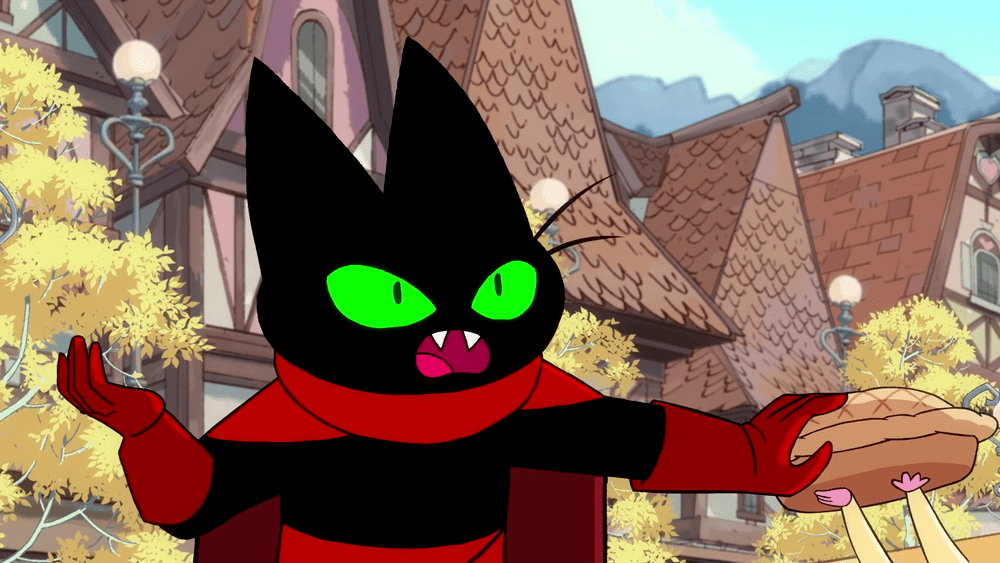
Mao Mao, the protagonist. He sounds a bit like Batman, that’s how you know he’s a good guy.

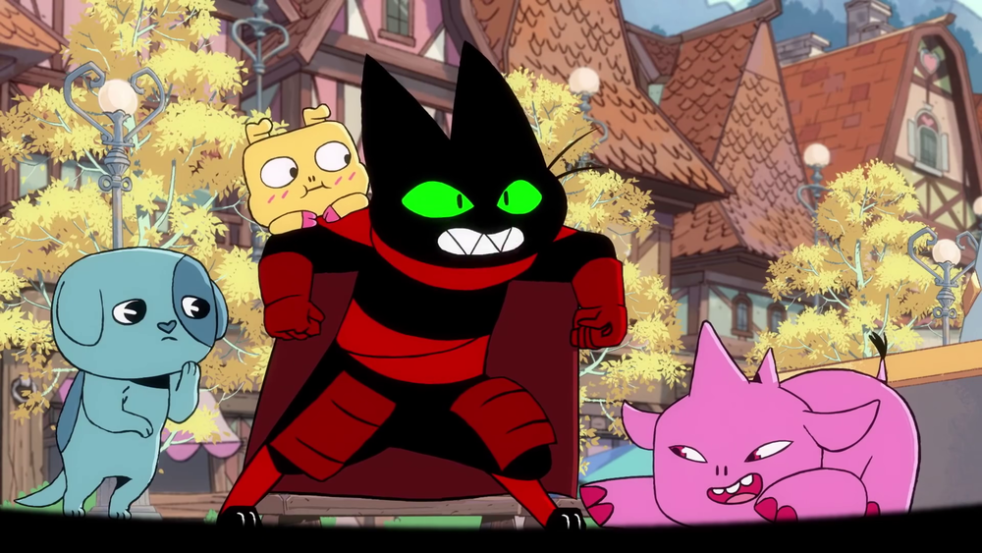
Thus, we have Mao Mao: Heroes of Pure Heart. Set in something akin to a lower-fantasy version of Adventure Time’s Kingdom of Ooo, our three leads are the titular Mao Mao and his friends / roommates / co-heroes of justice Badgerclops and Adorabat. Their job, at least in theory, is the defense of Pureheart Valley, the sleepy abode where they live and act as “sheriffs”, which is populated by a technicolor gaggle of cutesy animal-people called Sweetypies. 

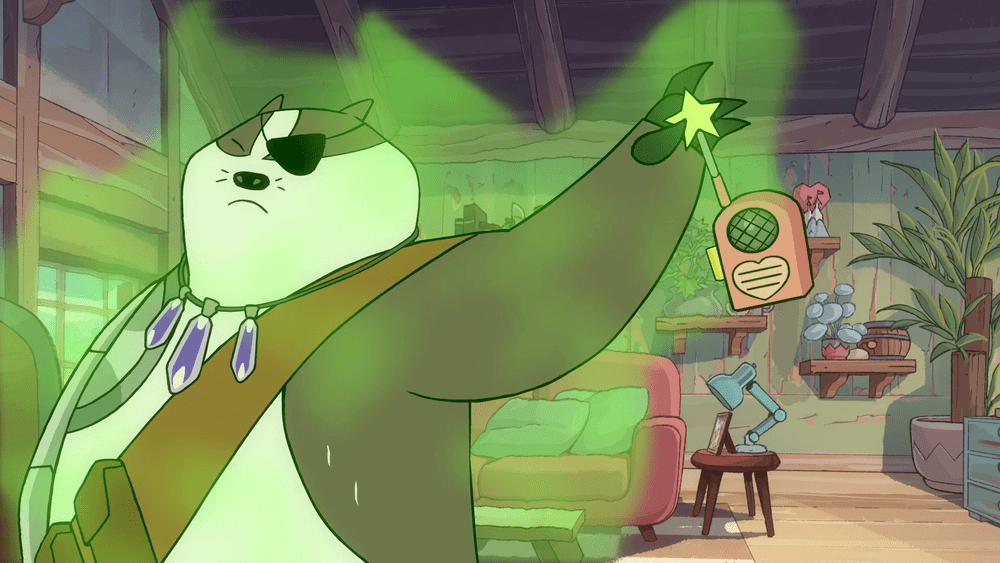
Lest one get the wrong idea about Mao Mao, the series’ (actually quite thorough) fan-wiki singles out just six of the 40 episodes that make up the first season as having “full story progression”. This is not a cartoon where the narrative through-line is the main focus. It is also, it should be emphasized, not a series that likes to neatly package itself into simple life lessons. Many episodes either subvert their apparent theme or never bother to build one up to begin with. What, for example, would one make of “The Truth Stinks”, an episode chiefly about how Badgerclops does not like to shower and resorts to hokey new age trinkets to “purify his toxins” instead, and thus smells bad as a result? Maybe, one could argue, that the target audience should shower, but the episode itself doesn’t really go that route, and neither do almost any of the episodes that seem inclined toward a simple lesson. 
Mao Mao, thus, tends to eschew easy morals in favor of presenting itself as “pure” comedy. Comedy that is, by and large, quite solid. Mao Mao’s characterization as a self-sabotaging neurotic is fairly rare among this kind of series. And while it’s not hard to sympathize with the guy, he does run himself into the ground so often that you can’t help but laugh, too. Occasionally to the point of a full-on odyssey, as in say the absurdly-named “Mao Mao’s Nakey”, where the herocat loses his clothes to a stray gust of wind and must dart around town frantically to find them while avoiding the prying gaze of his constituents.
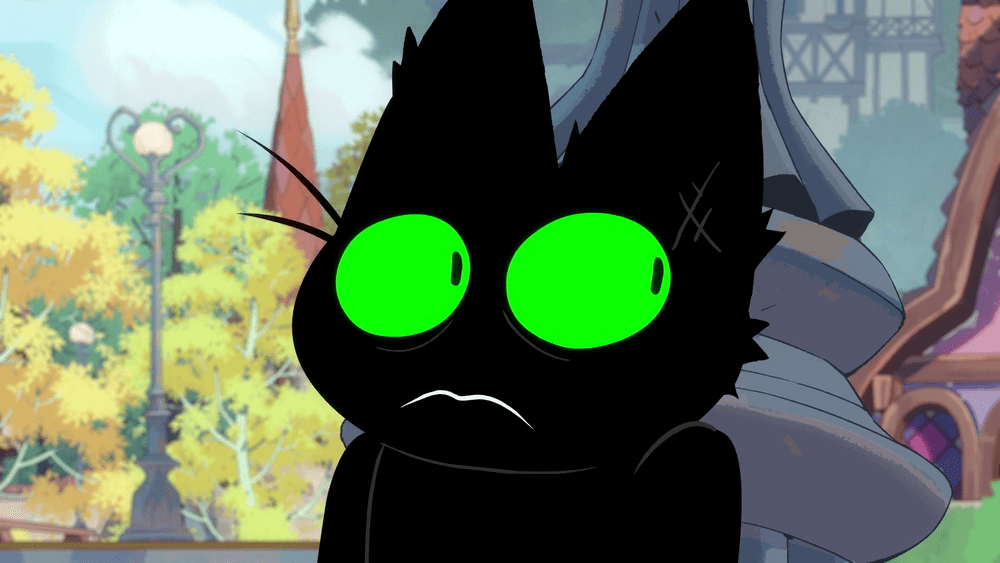
There’s a lot of terrible jokes one could make about this image. I respect my readership, so there are none in this caption.

Mao Mao‘s general vibe may have something to do with its pedigree. In addition to another entry in this subgenre, OK KO!, showrunner and voice actor Parker Simmons has a history with [adult swim] that includes Metalocalypse and Superjail. The adult subject matter is largely absent from Mao Mao, of course, but an [as]-like sense of humor does run through the series.

Like many of that sub-network’s shows, the weaker episodes here tend to take their comedic grounding to an unfortunate extreme. As a result they often feel less like episodes and more like just a sequence of Things Happening. Occasionally the jokes hit oddly, too. “Popularity Conquest”, an early episode full of ambiguously-intended swipes at other Cartoon Network shows (going especially hard at Steven Universe), is a prime example. By far the worst though is the series’ occasional attempts to frame its protagonists’ cop status as a joke. Gags involving riot gear and the failures of the justice system have arguably never been funny, and they certainly aren’t in 2020. These particularly egregious examples are, thankfully, rare.

One could thus argue that Mao Mao has something of an issue with undercutting its own emotional core. But on the other hand, when it does let that core come through untouched, it tends to make for the strongest episodes of the series. Mao Mao’s judgmental, emotionally abusive, perpetually-disappointed father, Shin Mao, haunts him, (sometimes literally, as in “Scared of Puppets”), and informs his character flaws. The show is named after him, so it’s fitting that Mao Mao is the most rounded character in the series. More than even many more serious shows, Mao Mao understands that trauma tends to outlive the malice or carelessness that births it. 
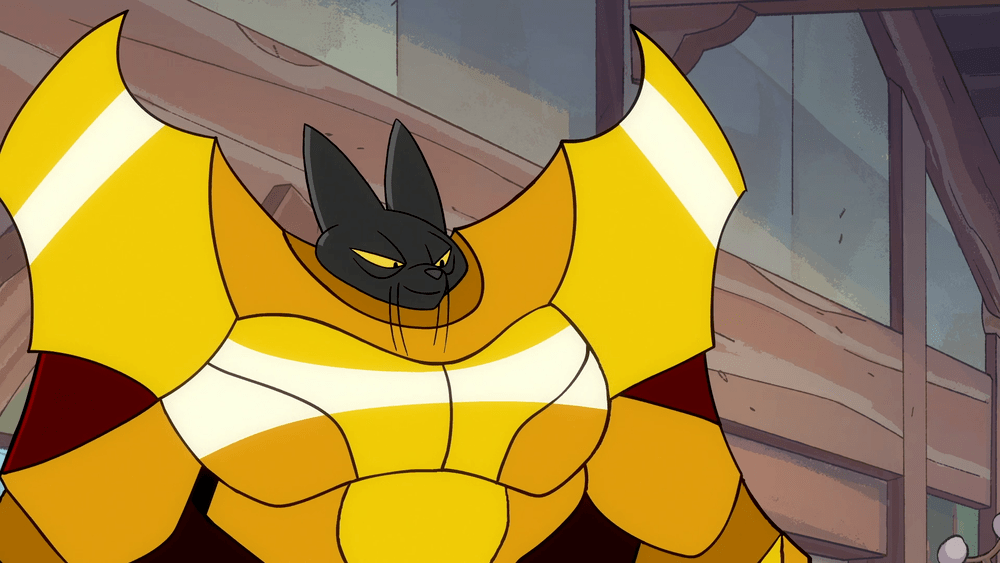
Shin Mao doing what he does best; looking vaguely condescending.

“Small” does not end with Mao Mao overcoming his complex. Even at the episode’s end, when he saves his father from a rampaging beast, finally earning his respect, Mao Mao is apologetic and self-deprecating. Later episodes like “Super Berry Fever” or the aforementioned “Scared of Puppets” illustrate in a surprisingly subtle way how the fallout from malformed family relationships can infect the most random of things, damaging one’s emotional functionality well into adulthood. The idea that fruit cobbler or a fear of ventriloquist dummies could possibly reflect deeper emotional trauma can seem superficially ridiculous, and the series is in fact occasionally guilty of treating it that way. But in general, these episodes are the strongest of the series, and bely a more thoughtful emotional sensibility than one might assume.

The other two leads, and their own sets of issues, get a similar focus, though not as much. Adorabat in particular is the star of “Adoradad”, perhaps the single best episode in the series thusfar and its most straightforward story-driven adventure to date. “Adoradad”, in fact, with its complex family dynamic, impressive art, and commendable economy of character, may point to a way forward for Mao Mao on the whole. 
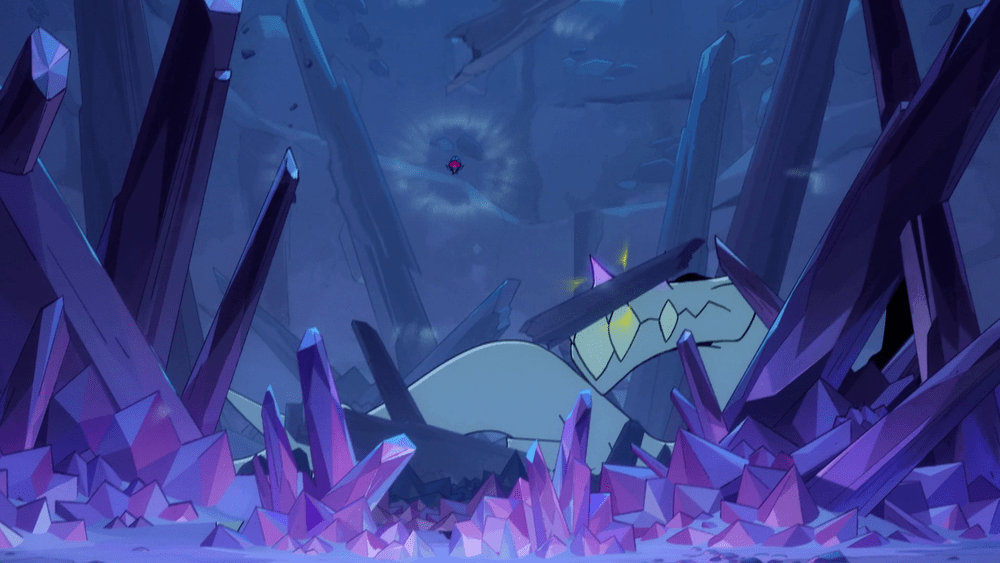
As good as Mao Mao can be–and at its heights, that’s a good deal more than your average jaded animation fan may expect–what it feels like it’s missing is that sense of forward drive. “Adoradad” offers up the notion of Mao Mao as a more narratively-driven experience. Still with laughter at its core, but with a more ambitious goal of weaving sophisticated stories for its young audience without falling into being rote or crass. In a very literal sense, the story of Mao Mao is still being written, and if there’s anything worth hoping for, it’s that like Adorabat herself, it lives up to its potential.


If you like my work, consider following me on Twitter, supporting me on Ko-Fi, or checking out my other anime-related work on Anilist or for The Geek Girl Authority.

All views expressed on Magic Planet Anime are solely my own opinions and conclusions and should not be taken to reflect the opinions of any other persons, groups, or organizations. All text is owned by Magic Planet Anime. Do not duplicate without permission. All images are owned by their original copyright holders.

in defiance of the Sun: The Eternal Midnight of ZUTOMAYO

Depending on how often you use the site, and what your browser history is like, you may recently have seen this two-tone haired character staring out at you from somewhere in your Youtube recommendations.

That’s how I first learned of Zutomayo, at least. The rock group’s full name (Zutto Mayonaka de Iinoni) means something like “I wish it was midnight all the time” (or more liberally and poetically; “Midnight Forever”), a phrase that gives some indication all on its own where the group are coming from. If you want the traditional rock critic-delivered backstory spiel, there isn’t much of one for Zutomayo. The group consists of the pseudonymous ACA-Ne and a cadre of other musicians, and are only a few years old. (Their debut single “Bite The Second Hand” dropped in 2018.) Despite all this; the group are no cult act, at least not domestically, with their two EPs ranking high both on Billboard of Japan’s Hot 100 and the pickier Oricon album charts.

But I’m not that interested in explaining why Zutomayo are popular. I think that’s pretty obvious; they’re a really good band with impressive chops that also tend to put their songs behind compelling and creative animated music videos. That they are well-liked makes perfect sense.

I am interested on a more personal level, here. It’s not much an exaggeration to say that Zutomayo are the most I’ve cared about what could probably be defined as an actual rock band since I was a teenager, being someone who mostly grew up on top 40 and later hip-hop as my preferred music formats of choice.

I first became aware of the “Study Me” video not long after it went live. The first time I listened to it, I “only” liked it. I saved it to a youtube playlist I keep good pop songs in, but I didn’t have an immediate strong reaction to it. How doing that tends to work for me is that I play something a few times, eventually get sick of it, and remove it from said playlist. (Very sophisticated, I know. This is why I’m not a music critic in any serious sense.)

The second time I heard it, something….clicked. I don’t know if it’s that I was also watching the music video with full attention this time, or if it was just something in the way ACA-Ne yells “FUN-KY!” during the chorus, but I was completely blown away. I listened to it back to back several times in a row (something I almost never do) and immediately started seeking out other songs by the band. I’ve developed my favorites over the relatively short time I’ve known of Zutomayo, but it took until I stumbled upon a video by Youtuber Steve M. (I don’t normally like that kind of thing, but Steve’s video is one of the few solid sources of English-language information on Zutomayo and I think it’s quite good) for me to start really considering why this group’s music was resonating with me so much.

“Study Me” is a very defiant song. I’d argue you don’t need to understand a single syllable of the lyrics to get that; the music video’s background-character-gone-rogue plot makes it pretty clear. But Zutomayo’s songs, from the admittedly imperfect information I can gather via translated lyrics, often seem to traffic in two broad themes. One is alienation; from society as in “Study Me” or from other people via failed romantic or familial relationships, as in say “HAM” or indeed the aforementioned “Bite The Second Hand”. The other is defiant, sometimes radical self-reinvention, as in (again) “Study Me” or even “MILABO” which kind of appears to wed the two themes.

I’ve seen the popular theory floated that every one of Zutomayo’s two-tone-haired MV protagonists are actually the same character, either in alternate versions or at different stages of life. This is perhaps a little too heavy on capital-L Lore for most “serious” music consumers, but I think the idea is at least thematically sound. I won’t claim that I can “prove” that all of Zutomayo’s songs are autobiographical excerpts from ACA-Ne’s life, but she’s a good enough songwriter that whether or not they’re grounded in concrete reality doesn’t really matter. (And, this must be tempered with the claim I’ve seen from more than one song translator that Zutomayo’s lyrics tend to be….poetically circumspect, which can make concrete readings difficult even in the native language, but that’s not anything that’ll be news to say, fans of American indie rock. Plus, I’d argue that all truly great art is open to a plurality of interpretations.)

As a side note that I tried and failed to work into the main body of the article: the best scene in “Study Me” is where the camera zooms out and she sees all the footage of her alternate lives (or whatever they are) playing. You cannot change my mind on this.

Since properly “getting into” the group–that is to say, not long after watching that video– I sought out a fan community who have been nothing but pleasant to me (hello Zutomayo Zone!), which brings us to the present, and my own ruminations.

Alienation, failed relationships, distance from society, the pinpricks of light that constitute occasional and sometimes radical self-reinvention….it clicked for me sometime yesterday. I have no idea if ACA-Ne is part of the LGBTQ community (it’s not like anybody right now has any lack of reason to feel like it’s them against the world), but these are themes and ideas that tend to resonate with that community, which I am part of. Once I realized that, everything fell into place.

I’m not saying this character is necessarily trans, but come on one of the versions of her is a catgirl with striped blue and pink leggings.

Anecdotally, a good chunk of English-speaking Zutomayo fans I’ve met are queer or otherwise marginalized, and I would not be even remotely surprised if that holds true for much of the Anglophone fanbase in general. It is totally possible to read “Study Me” in particular as a defiant demand for understanding an acceptance–the song’s not called “Please Study Me”–and even if that’s a million miles away from its original intent, I’d argue it’s as valid a reading as any.

I have not made any secret of the fact that I’ve been in a rough mental spot recently due to recent events. Perhaps Zutomayo is just the music I needed for the moment. If that’s true, I wouldn’t quite say that Zutomayo saved my life, but it’s the closest any band has ever come. (An honorable mention should go to The Ataris, who got me out of a similar rut several years ago, but I never felt the same immediate connection to their music.) Given the specifics of my life and hell, just the world right now, I can completely understand, say, wanting to break out of the depressing shell you find yourself in and becoming a cute space idol instead.

Not that this song is exactly cheerful, but no one’s here for sunshine. The band is called “Midnight Forever“, after all.

This, of course, is not accounting for the more immediate appeal of Zutomayo’s music. I’ve often noticed that in particular I cannot quite tell if certain things in a given Zutomayo song are being played on “actual instruments” or if it’s actually very convincing programmed production. It usually at least sounds live, but it can be surprisingly hard to tell! Either way; the band’s timbrel palette is one of my favorites I’ve heard in years, especially the downright fatal bass on some of their funkier songs (“Study Me” once again and the slightly more recent “JK Bomber” come to mind here). This is without even mentioning ACA-Ne’s sharp, clear voice, which has a wonderful bright quality to it that I just don’t hear that often on either side of the Pacific.

I’ve since learned that Zutomayo are not completely without peers. One of the greatest music-related shocks of my life thusfar was learning that there’s an entire world of Japanese rock and pop that just kinda sounds like this–a non-Zutomayo track I’ve been greatly vibing with lately is Yorushika’s heart-rendingly depressing “That’s Why I Gave Up On Music“.

But there’s just something that, even after writing all of this, is unquantifiably special to me about Zutomayo. Maybe some of us just gravitate toward the nighttime, and maybe Zutomayo make music for those people. For those times when morning seems more like a curse than a blessing, I can think of no better act in music right now.

CORRECTION: This article previously stated the entire group was anonymous. This is only the case with lead singer ACA-Ne, who is only known by her pseudonym.

If you like my work, consider following me on Twitter, supporting me on Ko-Fi, or checking out my other anime-related work for The Geek Girl Authority or my archived reviews on Anilist.

All views expressed on Magic Planet Anime are solely my own opinions and conclusions and should not be taken to reflect the opinions of any other persons, groups, or organizations. All text is owned by Magic Planet Anime. Do not duplicate without permission. All images are owned by their original copyright holders.

and now, this.

Making a WordPress blog in 2020 feels so incongruous that it’s almost funny. Yet, here I am, adding a third Writing Thing to my plate.

If you’re reading this, you already know who I am (if you don’t, how on Earth did you find this place? No seriously, tell me, it’ll be great for my SEO) and what I’m about. But just to reiterate: I talk too much about anime. Sometimes, I even get paid for it. Right here on WordPress though I’m mostly going to be posting stray thoughts and stuff I never quite finished from elsewhere. I do plan to liveblog the new Pretty Cure when it launches in a week though, that’ll be chill, right? Regardless, this is going to be more relaxed and casual than most of my writing. I like thinking of my anime-related writing as documenting a personal journey, and I think returning to my roots a little bit will help in that regard.

Hope y’all choose to stick around. Don’t be afraid to subscribe if you like what you see ✌