Hi friends, I’ll make this as short as possible. You’ve probably noticed that there was no Spy x Family recap yesterday. (It may still technically be “today” for a few of you, since this is going up at….1am, my time.) My initial plan was to simply move the recap to Sunday, but things have been complicated the past couple of days, and on top of that I’m not feeling terribly well. I’m instead going to be skipping this week’s recap all together, and there will not be an Anime Orbit Weekly this week, either. (I do encourage you to check out the Spy x Family episode regardless, it’s technically a “filler episode” in that there aren’t really any major story developments that aren’t a foregone conclusion, but it’s extremely entertaining.)
The next article that goes up will be the Healer Girl recap for this week, which itself may be up to a few days late. I appreciate your understanding in this matter, and if you’d like to support the site while I take some small time away so I can come back at full strength, as it were, that’d also be appreciated. (Although certainly, you have no obligation to do so and I don’t want to make it out as though you do.)
I will also note that I will still be reachable on Twitter and RetroSpring during this time if you have anything you’d like to contact me about.
Hi folks. As is often the case with these short little update articles, this is more of a PSA than an article per se.
I’ll cut straight to the point: no one but me is watching CUE! I have spent some time going over the metrics and it simply isn’t pulling crowds. Not just here, it doesn’t really seem to be doing well anywhere. It’s a non-entity on reddit, Twitter, etc. The Internet simply does not care about this show.
Which is a shame, because I genuinely like the show. But it now being three weeks into the season I have to ask myself if I like it enough to cover it weekly for two entire cours when almost no one is reading what I write about it. The answer there is a firm “no.” I do what I do out of love, but I must make some sacrifices for practicality. It is just not sensible from any point of view to continue to devote this much of my time to covering CUE!
So here’s what’s going to change, in the briefest terms I can put it.
Weekly Let’s Watches of CUE! will stop.
Consequently, CUE! will become a show I cover occasionally on The Frontline Report.
Sabikui Bisco will be taking its spot as a weekly. I really like it, and it’s getting enough positive buzz that I’m confident my columns on it will be more widely-read than those on CUE!
There will be a short Let’s Watch post–my first for the series–on episode 2 later today. Regular coverage will pick up when the series’ next episode releases on Monday.
Because this will shuffle around my work schedule, The Frontline Report will release on Tuesdays for the remainder of this season, in order to keep all my publishing days in a row. Starting with the upcoming edition of the column, which will now be released on the 25th. (The day that the Frontline Report is released depends on a lot of factors, but one of them is what’s most convenient for me. If I’m publishing something on Sunday and Monday already, then Tuesday is the natural fit.) Update: None of this is true! I misremembered what day My Dress-Up Darling comes out on. They will remain a Sunday feature for the remainder of the season.
I suspect most of you will be neutral on or happy with this change. For anyone who did enjoy my coverage of CUE!, I’m sorry that this has happened. I try to avoid switching things up like this in the middle of a season if I can help it, but, well, see my prior point about practicality. I hope you’ll look forward to its appearances in The Frontline Report, at least.
For the rest of you, I hope you enjoy the Sabikui Bisco coverage as much as I enjoy the series itself. I’ll see you later today with the Let’s Watch column.
Hi folks! As with a couple other things I’ve written lately this is less an article and more of a PSA, though it’s a bit more involved than some of the others I’ve put up recently.
Basically, now that all of my material for the year’s end is written and published (capping with my end-of-year list from yesterday. Read that if you haven’t!) I wanted to talk about my plans for 2022. Mostly in terms of what you can expect from this blog on a week-by-week basis, but I’ll also briefly touch on some other stuff. Before I start, I do want to get out that I know my reader base (that’s y’all) are pretty understanding and few people, if anybody, expect me to be mechanically consistent 24/7-365.
Nonetheless, I do want to try to hold myself to a higher standard in the coming year. I don’t like to talk about this side of running the site because I feel it’s a bit tasteless, but it’s pertinent here; 2021 was the year I started genuinely making some decent money off Magic Planet Anime. I’m still not where I’d like to be in terms of income, and if I’m being perhaps way too frank, I can still only just barely take care of myself even with the assistance of my loved ones, but it’s a great start, and I’m deeply grateful to everyone who’s donated any amount even once.
I bring all this up because part of the reason I want to hold myself to that higher standard is because I want to make you all feel like you’re actually paying for something worthwhile. I can’t realistically promise to always be the smartest or most insightful anime critic on the internet, but I can aim for honesty, thoughtfulness, and consistency. Your donations over the past year have allowed me to do that, and I’m hoping I can deliver on that front even moreso in 2022.
So, with that out of the way, let’s talk plans.
The Future of Let’s Watch
Let’s Watch was one of the things I started on in 2021 that I was least confident in. Which, in hindsight, is pretty funny. It served as a replacement for my former work for GGA. Recap-breakdown-writeup-whatevers about an anime episode once a week, more or less. While it didn’t go perfectly, my takt op. recaps were some of the most engagement my site’s ever gotten. Obviously, I intend to continue doing these in 2022, since people evidently want to read them. But there is a change to take note of.
Most seasons, I will be covering two shows a week, not just one. One anime will be a seasonal Community Choice. You can find out more about the latter here(and get in a last-minute vote if you haven’t already. I plan to close the poll sometime shortly after the new year). The other will be whatever I happen to pick from the seasonal crop of anime I do First Impressions posts on. In the rare event that I can’t find anything I want to cover; I might run another poll or just stick to one show for that season. (I don’t expect this will happen terribly often, if ever, but it’s nice to have a contingency plan in place.)
Reviews in the Rearview?
Traditional Reviews have historically been a thing I focus on here. While I’m certainly never going to stop writing them here, they will be less of a focus going forward, especially in terms of writing them for seasonal anime. Aside from the fact that when I do write a traditional review, it will hopefully make it “mean” a bit more, there’re a couple of other reasons for this:
Everyone does reviews. When I write a review I’m competing with every user-written review on MyAnimeList and Anilist, dozens upon dozens of other blogs, and so on. They simply aren’t a good way to get new eyes on my site most of the time.
My ability to advertise reviews is very limited. I can do some amount of SEO magic, but there’s ultimately a limit on that. And since Anilist no longer allows me to advertise my site when I mirror reviews over there (a way I was able to get some users to follow me from that site to this one), I have even less incentive to review every seasonal anime I finish.
Seasonal coverage always competes with Youtube videos. This is the big one. I simply cannot compete with the pace and engagement that your average Youtube video on seasonal anime gets. In some cases (like my Let’s Watch column) it’s still enough that I’m willing to try anyway. But review posts on this blog are never going to get even a meaningful fraction of the views that, say, a Youtube video with a flashy thumbnail and a title like “The PROBLEM With takt op.Destiny!” is going to get. That’s just the nature of the landscape right now and will continue to be so for the foreseeable future.
What all of this boils down to is; I’ll be largely saving full, traditional reviews for either A) older anime, where there tends to be far less of a glut of competition, B) seasonals I have very strong feelings on, whether positive or negative, and C) movies, which brings us to our next subheading.
Monthly Movies & Manga
This is the big change. For most of this blog’s lifespan I’ve been very lax about getting “extra articles” out there. Stuff like my Monthly Movies column or my Manga Shelf column. I want to change that, because these are some of the projects here that I’m most passionate about, and they are the sort of thing that there is less of, so the field isn’t quite as crowded.
I want to do at least one Manga Shelf column or one Monthly Movies column a month. If I’m going at a good clip by mid-year and am feeling ambitious, I might up it to two. Consequently! If you’re a big anime film buff or read a ton of manga, feel free to toss recommendations my way, I’ll even credit you in the lead-in for any articles I write on them. (And for our purposes here, single-episode OVAs count as “movies.” I won’t tell anyone if you don’t, alright?)
The Front Lines March On
The Frontline Report, my honestly pretty stupidly-titled weekly writeup of whatever I happen to be thinking about at the time, is the column that will change the least going into 2022. I will still aim to write it once a week, although it’ll remain the column I’m most likely to suspend if I’m ill or something of that nature. The only real change here is that the specific day I publish the column on might change from season to season as different things will work better with my schedule.
That’s most of the specifics. I do have some more general goals, such as wanting to do some more collaborative stuff, and some longer-term ideas (I’d like to break the readership record I set here this past October, for instance.) Beyond that, though, that’s pretty much what 2022 is going to look like, barring some kind of unforeseen circumstance.
With all that laid out, I hope to see you all back here in the new year. I don’t have my plans for next season entirely set in stone yet, but it shouldn’t be too long into January before you start seeing me post here again.
Until then, anime fans, thank you for your support over the past wonderful two years of running this blog, and happy holidays. 🙂
Wanna talk to other Magic Planet Anime readers? Consider joining my Discord server! Also consider following me on Twitter and supporting me on Ko-Fi or Patreon. If you want to read more of my work, consider heading over to the Directoryto browse by category.
All views expressed on Magic Planet Anime are solely my own opinions and conclusions and should not be taken to reflect the opinions of any other persons, groups, or organizations. All text, excepting direct quotations, is owned by Magic Planet Anime. Do not duplicate without permission. All images are owned by their original copyright holders.
Important Update: If you voted before approximately 10PM EST on 12/9/21, please click the link below and resubmit your response(s). The survey site I initially used was not working properly and they weren’t recorded.
Hi anime fans, this is less of an article and more of a PSA. When the year rolls over and the anime season, accordingly, shifts, I’m going to be launching a new edition of the Let’s Watch column after the current series I’m covering there, takt op.Destiny, ends.
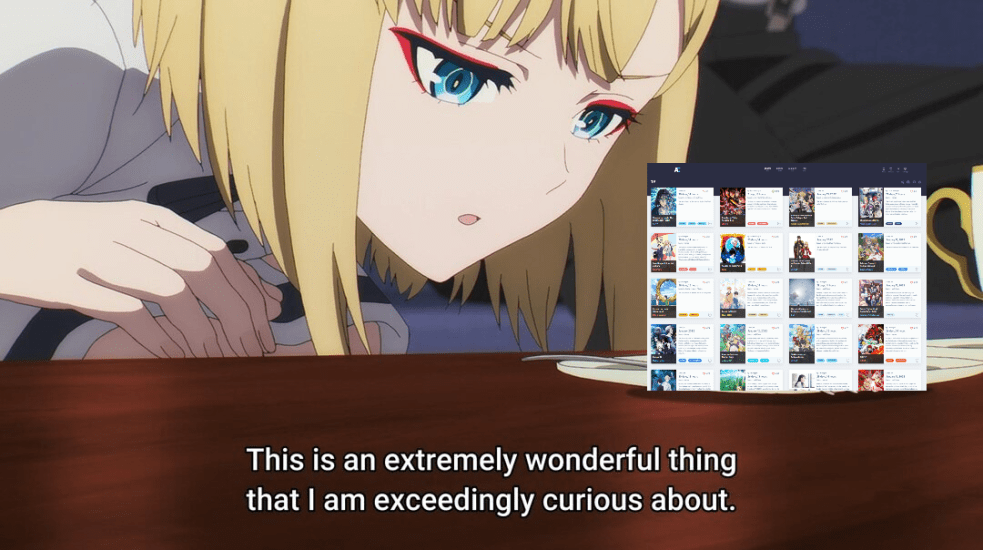
And not to beat around the bush; this is where you come in. I’ve whipped up a good old-fashioned poll containing a list of what is, to my knowledge, every original or premiere adaption anime being made for the Winter 2022 anime season. They are presented in the order found on Anichart.net. (With the exception of World’s End Harem which I accidentally moved a few spaces down. I do hope you’ll forgive me there.)
The list uses official English names where applicable, and transliterations of the Japanese titles where there isn’t currently a known official English one, sometimes followed by a fan-consensus English name after a slash.
Which is to say; vote to your heart’s content on what you’d like me to cover on the column next season. I will ask of course, that you only vote for anime you’d actually be interested in reading my coverage of. But interest takes many forms, so beyond that I’ll not attempt to restrict you. You can vote for any number of anime, and if I need to, I may launch a second poll as we get closer to January as a sort of elimination round.
Wanna talk to other Magic Planet Anime readers? Consider joining my Discord server! Also consider following me on Twitter and supporting me on Ko-Fi or Patreon. If you want to read more of my work, consider heading over to the Directoryto browse by category.
All views expressed on Magic Planet Anime are solely my own opinions and conclusions and should not be taken to reflect the opinions of any other persons, groups, or organizations. All text, excepting direct quotations, is owned by Magic Planet Anime. Do not duplicate without permission. All images are owned by their original copyright holders.
Seasonal First Impressions is a column where I detail my thoughts, however brief or long, about a currently-airing cartoon’s first episode or so.
Back in 2018, when “Crunchyroll Originals” had not yet become a deeply toxic pair of words, the streaming service announced its first slate of original programming. On that slate was High Guardian Spice. This article is only slightly even aboutHigh Guardian Spice, because to talk about HGS is to talk about its bizarre circumstances of creation and how Crunchyroll has handled it, a horrible boondoggle that I would wish on nobody. As for the show itself, full disclosure, I am basing all that I am about to say off of High Guardian Spice‘s first episode, to give it parity with, you know, every other show I’ve done a writeup on this season. I feel it’s only fair.1
So about that initial 2018 announcement. We didn’t know much about HGS; the show had a soft, rounded art style, early press materials boasted of it being written by “100% female writers”, and….honestly that was sort of it. Cultural currents conspired against the series; the Gamergate-derived reactionary movement within anime fandom descended on it like vultures to fresh carrion. It was decried as an assault by whatever word-scramble the alt-righters had managed to smash together that particular week. An assault not on anime alone but on you too, specifically, dear otaku, who were being replaced by legions of evil feminist SJWs with dyed hair. It was all very awful, hateful, melodramatic, and pointless.
Even at the time, this all seemed astonishingly ridiculous to anyone with two braincells to rub together. Crunchyroll had no qualms about airing things that demonstrably aren’t anime before, and it would have no qualms after. The idea that this show specifically was somehow going to be the straw that broke the camel’s back is absurd, even as someone who really does think that the ongoing pan-corporate attempt to rebrand any non-comedy cartoon not aimed at children as “anime” is somewhere between stupid and insidious. But, companies listen to internet outrage, no matter how contrived it is and no matter how much they might like to pretend they don’t. Spice was, thus, shelved for a time. Despite being finished sometime in 2019, it’s only “premiered”–read: was unceremoniously kerplunked down in a single, twelve-episode data dump–today. Its promotion amounting to a banner across the site’s top that will, I imagine, mostly serve to rekindle that tedious, performative, reactionary flareup, until it is eventually replaced by a banner advertising a new episode of a mediocre isekai.
And all that for this.
Even with just 20 minutes of footage to judge on, this is not a series that merits all that guff. High Guardian Spice is a very simple show, and its only real problem is not even a problem with the show itself; it’s where it is. It’s an issue so astoundingly unfair to the series itself that I feel bad bringing it up. But, that’s the fact of the matter. The show is a Crunchyroll exclusive, sitefellows with Attack on Titan and Demon Slayer and The Great Jahy Will Not Be Defeated. It is probably, as a result, totally doomed. I can imagine a smidgen of demographic crossover with the same section of Crunchyroll’s audience that leads to things like ancient newspaper comic strip Rex Morgan, M.D. namechecking Kira Kira Precure A La Mode. Beyond that? I really don’t see it.
It’s a shame, too, because the show is pretty good! As an anime critic (in as much as any person is one), I consider myself used to the tropes, structures, and rhythms of Japanese animation moreso than other sorts. And yeah, as everyone correctly predicted from day one, High Guardian Spice is a very American show, which makes it a bit of an odd watch if you’re expecting something built like an anime, but that’s not a bad thing in of itself.
Our premise here is very simple; village girls (and I am pretty sure, girlfriends) Rosemary and Sage are off to join a magical school, where they will be trained as Guardians. What’s a Guardian? Presumably they protect the world from evil of various sorts. It’s not gone into too deeply in the first episode. We mostly learn that Rosemary (she’s the rowdy pink one) wants to be a warrior, Sage (she’s the quiet blue one) wants to be a healer, and that Rosemary’s also-pink mom was also a Guardian. (She seems to be somehow missing rather than outright dead, lest anyone accuse HGS of riffing on Steven Universe too directly.) Rose and Sage do not actually attend the magical school–High Guardian Academy–in this first episode. Instead, they move to the city of Lyngarth and in with Sage’s cousins (also a very obvious lesbian couple), and get the lay of the land.
This gives the first episode a rather slice of life-y feel. The memorable stuff here is the character details; bits like Rosemary excitedly postulating that a striped, ferret-like creature “might have rabies”, a pair of interactions with an aloof elf, even simple things like her habit of loudly “AHH!”-ing when startled, these are all good, solid character-building. It’s cute, and it’s charming. Rosemary and Sage’s relationship deserves special mention here, as it’s clear even this early on that they care for each other a lot. This, perhaps, is the main thing from that silly “100% women” quote that actually shines through, here. They do have a genuinely very sweet relationship and I’d be interested to see how it develops over the course of the show.
As for the more serious, plot-heavy stuff? It’s there, but if it ever does develop into something more compelling, it must take some time. It’s very barebones this early on, mostly consisting of “Rosemary’s mom is missing” and something very vague about “old magic” and “new magic” being two things that don’t necessarily mix. To be fair; leading with something lighter and only building up to the actual meat of things later on is pretty standard for this kind of thing, so it’s hard to hold this against the series.
And honestly? That’s High Guardian Spice‘s premiere in a nutshell. It’s solid, if perhaps not entirely my thing. (I think being involved in the Steven Universe fandom during the show’s height of popularity may, sadly, have killed my interest in this genre, whatever you’d call it, for good.) I think that given a better home HGS could find the audience it truly deserves. It’s hard to argue it’s not a victim of Crunchyroll’s ramshackle, neglectful IP handling. I committed myself to checking out the series because I wanted to see what the actual cartoon was like. What was hidden behind all those layers of corporate brandspeak and performative reactionary rage. What I’ve found? A perfectly good little cartoon that didn’t get a fair shot. I can only hope that I’m wrong and actually does attract an audience that truly appreciates it, despite all odds. It deserves better than this, we all do.
Grade: B The Takeaway: If you’re a fan of latter-day Cartoon Network and Disney’s TV fare, or of Little Witch Academia, you should give this a look.
1: I will note that the show opens with a hilariously incongruous warning that the program contains “strong language, violence, and sexual content.” I am pretty sure this is an error of some sort, although if the show does have some kind of weird mid-season shift into being edgy as hell, that would be….interesting, to say the least.
Wanna talk to other Magic Planet Anime readers? Consider joining my Discord server! Also consider following me on Twitter and supporting me on Ko-Fi or Patreon. If you want to read more of my work, consider heading over to the Directoryto browse by category.
All views expressed on Magic Planet Anime are solely my own opinions and conclusions and should not be taken to reflect the opinions of any other persons, groups, or organizations. All text, excepting direct quotations, is owned by Magic Planet Anime. Do not duplicate without permission. All images are owned by their original copyright holders.
When I was eighteen, I wanted to be a rap producer. In hindsight, with the self-awareness I now have nearly ten years later, it was a stupid idea. Like a lot of people whose ambition far outstrips their capability, I went to school for this doomed little fantasy. Perhaps predictably, I barely lasted six months, and a decade on the only thing I have to show for this part of myself that I mostly keep buried from public view is a lengthy bandcamp page of music no one listens to and a cloud of student debt that will loom over me for the rest of my life.
I bring this personal anecdote up not to needlessly self-deprecate, but to explain something about The aquatope on white sand, and how I find myself unexpectedly relating to it. Fundamentally, most popular fiction that deals with aspiration deals with fulfillment of that aspiration. It makes for an easy-to-plan story arc and it concludes in a satisfying ending. Your protagonist(s) want to become a dancer, or a singer, or an actor, or whatever. Across some amount of story-units, they struggle and fight, that distant mountain still in reach, and they eventually achieve their dream. In anime a common manifestation of this particular story-type is that of the idol anime genre (of which there is one airing right now), relevant here because aquatope‘s protagonist, Fuuka Miyazawa, is a former idol.
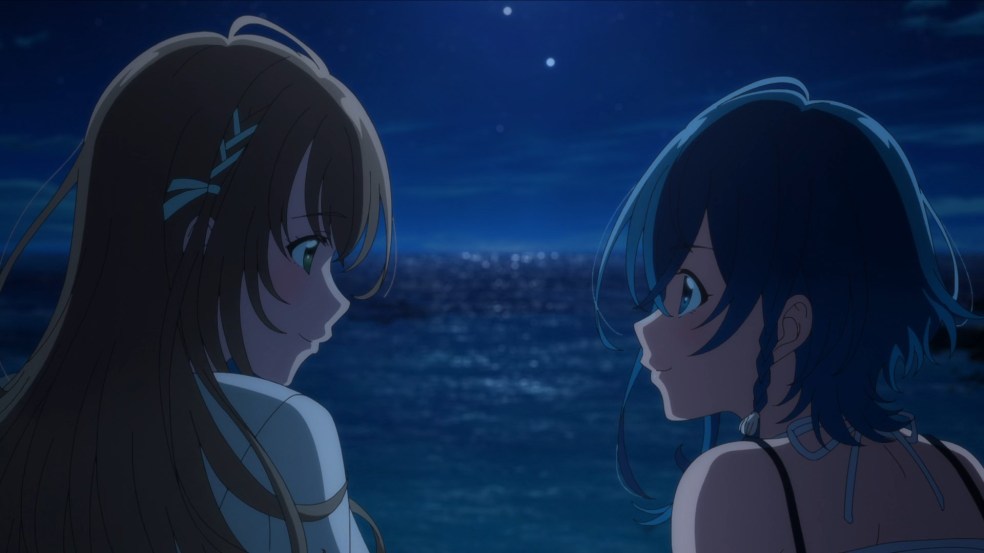
And that “former” is very important here. Fuuka begins aquatope with her brief career as an idol already in the past tense, her departure from the industry uneventful but bitter. (Its depiction in the first episode reminded me no small amount of one-off character Mana in Oshi No Ko.) She is adrift for much of the first two episodes, eventually settling in with the other lead, Kukuru Misatino, simply because the latter is willing to take her in. She’s hired by Kukuru’s aquarium, which is in financial tatters, and threatens to close at the end of the summer season.
At the tail end of the second episode, Fuuka realizes that even if she cannot fulfill her dream, she can help Kukuru with her aspiration of keeping the aquarium open. Where all of this will eventually go is not yet clear–aquatope is planned for a nowadays-rare two cours, so it has plenty of time to stretch its legs–but it’s clear that the series fundamentally understands that Fuuka’s renewed sense of purpose here is just as valid as her original goal to become an idol. That’s important, because the easy thing to do here would be to try to route her back into the industry, and treat that as the only valid form of “fulfillment”. That aquatope doesn’t do that is an excellent sign. (And gives me a lot more faith that its supernatural elements, which I haven’t mentioned up ’til now, will have some greater point, as opposed to merely being window dressing.)
Also, I suppose, naive as it may be, that I just see a commonality between myself and Fuuka. Criticism, or at least the mode of criticism I prefer to write in, is nothing if not the promotion of someone else’s dream. Uncountable hours go into any even remotely professional anime production, it is not a stretch to say that one making it to screen is the culmination of not just one dream but many. My approach makes for decidedly less interesting television, of course.
In its attitude toward Fuuka we find the first traces of what I suspect aquatope will eventually forge into its core thesis; the idea that in selfless lifting up of others’ passions one can find a way to rekindle, or reshape, their own. I am quite confident that by the series’ end, Fuuka will have found something new that fulfills her and brings her life meaning. And, yeah, I do relate to that, as someone who has turned this strange hobby that I picked up on a whim into a kind-of career without ever consciously planning to, I empathize with Fuuka quite a lot.
Beyond my own personal emotional mire; character writing this delicate is a rare thing, and while plenty of anime are good natured, not nearly as many can work in shades of compassion that are this subtle. aquatope is one to keep your eye on.
All views expressed on Magic Planet Anime are solely my own opinions and conclusions and should not be taken to reflect the opinions of any other persons, groups, or organizations. All text is owned by Magic Planet Anime. Do not duplicate without permission. All images are owned by their original copyright holders.
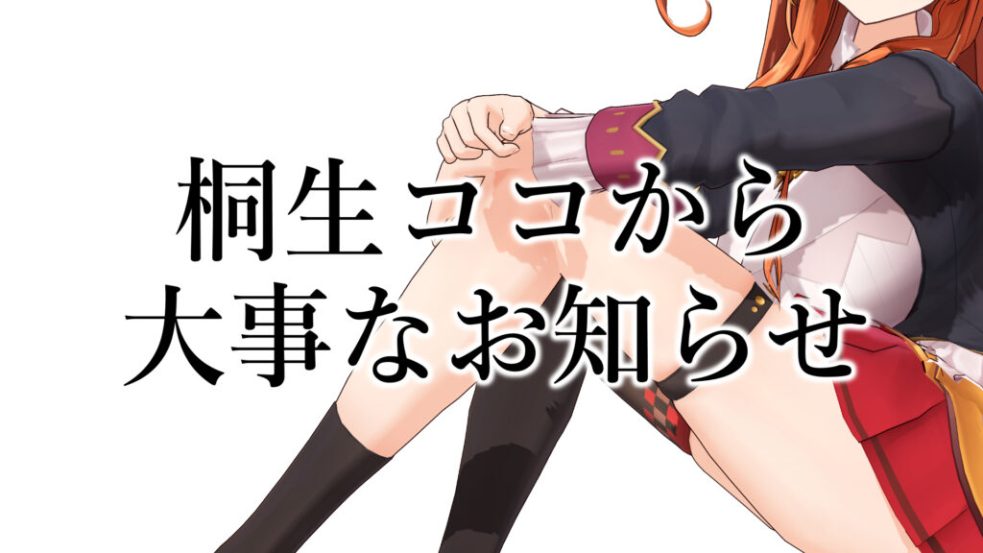
This is an anime blog, and consequently I don’t write about things that aren’t anime (or at least, related to it, say, manga.) very often. Consequently, I do feel out of my depth here, for more reasons than one. You may or may not know who Kiryu Coco is, why she’s leaving the talent agency (Hololive) she’s a part of, or why any of that matters, but if you’re familiar with Virtual Youtubers at all, you’ve probably at least seen a few of her clips.
Coco is an international superstar in a medium where that’s still a very new idea. She is probably the single most visible VTuber to ever retire (“graduate” in idol industry parlance, which the virtual talent industry has a habit of nicking). There is a hole that will be left in the digital landscape in her absence, and that’s worth contemplating. And, well, I’m reasonably sure she’d find the idea of “contemplating holes” to be at least kinda funny.
In truth, I’ve written and scrapped an entire other version of this article already. Talking about my personal feelings felt like the wrong approach; I am a fan of Coco, but not a diehard, and I know people who are going to take the loss of her talent much harder than I am. But, having typed out the objectively-minded from-a-distance version of this piece, that felt wrong too. So back to personal feelings we go. I figure exposing my own weaknesses as a VTuber fan is a small price to pay. She deserves this much, at least.
I first became aware of Coco not long after Hololive’s official English branch debuted. I was a latecomer to the phenomenon, and had just kind of assumed that like the idol agencies that virtual talent agencies loosely base themselves on, that most VTubers were, you know, idol-y. Pure, sweet, and definitely talented, but scrupulously professional. Maybe a little boring.
HoloMyth, as the EN branch is called, broke some of that illusion for me, but if one still thinks as I did, they should watch some of Coco’s work. She speaks in an odd, always slightly-strained sounding pitch, with a southern drawl even in Japanese. While she’s definitely capable of being genuine when the occasion calls for it, and seems like a nice person at heart, most people get into Coco because she is loud, rude, and swears like a sailor. “Good morning, motherfuckers!” is not a catchphrase someone takes up lightly.
Coco’s activities, I soon learned, supplemented the usual idol / streamer VTuber routine with a metric ton of assorted shenanigans. She reviewed reddit memes, casually fucked with other Hololive members, moved in with one of her genmates, sold drugs, got low during her 3D debut, and in one particularly memorable instance to me personally, streamed while tripped out on sleeping aids. Which she later re-streamed with her own mildly alarmed meta commentary.
One might naively assume that this sense of humor–very stereotypically “American”–would have made it hard for her to get a domestic fanbase, but she stands as one of Hololive’s most popular talents, both in Japan and abroad. Being funny but also having a big heart, as it turns out, is kind of a universal language.
Not that everyone is a fan, of course. I could, if I wanted to “do my job as a critic”, trot out the various controversies she’s been involved in, none of which were her own fault. I could even make (mostly quite minor) criticisms of my own. But why? Now is hardly the time.
It is clear, even to a casual observer, that being part of Hololive meant a lot to Coco. I could speculate on her reasons for leaving (Cover Corp claims it was a mutual agreement, and as cynical about companies of this nature as I can certainly be, I don’t disbelieve them), but to do so would feel disrespectful. What I will say is that I suspect she is irreplaceable. There will never be another Kaichou, and that is, from any reasonable point of view, a loss for Hololive, for virtual entertainment as an artform, for us the fans, for her fellow idols, and so on.
There’s a lot of pithy advice one could toss out. “Don’t cry because it’s over, smile because it happened” and so on, but it would not change the fact that this sucks. People have a right to tears, if they feel the need to cry.
The one silver lining for this, in as much as there is one, is that retirement is not death. While Hololive’s anonymity policies prevent her from explicitly saying where or when she will pop up next if she decides to ever pursue a career in the industry again, if she does, people will know. If she doesn’t, we can only wish her the best in life. And it is indeed our responsibility to do so, as fans.
Finally, as mentioned at the beginning of this article, Coco stands as perhaps the single most famous virtual entertainer to ever retire. There’s something to be said for going out on a high note.
I always struggle with ending articles, especially if they’re not happy ones. So, instead of worrying myself with what prose is the prettiest, I would like to share just one more Coco moment I’m inordinately fond of. Her first appearance in the HoloGraffiti shorts (one of sadly only a very few). In which she inexplicably decides to “do a raid”. It’s a cavalcade of wonderful nonsense, as most of the HoloGra shorts are, featuring fellow Hololiver Fubuki dropping “fun facts” and Coco herself doing….things. At one point there’s a T. Rex. Hearing her particular pronunciation of “Jurassic” is a delight, too.
I really can’t think of much else to say. Rarely do we get to dictate the circumstances of our meetings and leavings in this life. So in that one sense, and that sense alone, we can at least take some comfort.
Until we meet again, Kaichou.
This article isn’t very indicative of my general work. But if you liked it, you can consider following me here on WordPress or on Twitter.
This past week, the mass of loosely Japanese animation-related Twitter accounts broadly known as “AniTwitter” worked itself into a tizzy over an admittedly somewhat surface-level but harmless article on gaming website Polygon. That article’s author, Kambole Campbell, came under fire from anglosphere magical girl genre fans after the column (admittedly incorrectly) implied that Wonder Egg Priority was innovating in the genre space by dealing with the traumas of growing up.
To briefly satisfy the bloodhounds, yes, this is wrong. One need only to have seen the fairly recent-in-the-grand-scheme-of-things HeartCatch Precure to know that’s not true, and beyond that specific show or even the Pretty Cure franchise in general, the genre has been tackling this subject matter basically since its inception. I would argue that if Wonder Egg Priority makes a real innovation it’s merging that thematic core with an approach centered around surrealistic psychological imagery. Even there, it has forefathers. (That article also mentions Puella MagiMadoka Magica. It’s an obvious comparison, but not an incorrect one. And Madoka too has its own stylistic ancestors, of course, but this should go without saying, nothing exists in a vacuum.) Innovation is often only truly noticeable in hindsight anyway.
But Campbell’s minor error, mostly one of tone, doesn’t really matter here. And beyond the previous paragraph I don’t intend to much discuss the article itself at all, because I don’t think its content is terribly important to this issue. What’s been laid bare by this entire incident, which culminated in Campbell locking his twitter account and thus cutting off a vital source of networking for himself, is the truly dire state of anime fandom on social media.
This isn’t really surprising, if we stop to think about it. Broadly, the more niche a geeky interest is, the more intense its fans are. To abandon anime completely for a moment, look at the MCU. The cinematic universe’s most intense fans are not casual moviegoers, they’re the diehard core of Marvel comic fans for whom the films mark a public acceptance of what was for some time a rather obscure set of narratives. You go back fifteen years and much of the public at large doesn’t know who Marvel’s Thor is, much less the Guardians of The Galaxy.
So with this principal in mind, let’s apply it here. Anime as an entire medium is already a niche interest in the anglosphere, despite a resurgence in popular awareness over the last decade. Outside of mainstream TV shonen; the likes of say, My Hero Academia and a few other such properties whose merch you can find at your local Target, it is even moreso. It is not a surprise then that one of the most intense corners of online anime fan space is what might loosely be termed “magical girl twitter”. People whose passion for the genre runs wide and deep, not just Pretty Cure mega-fans (although those certainly exist), but folks whose knowledge extends back to the birth of the genre. Farther than mine, certainly.
In of itself, passion is a wonderful thing. I started this blog in part out of a desire to share my own. The issue arises when fans who share a niche interest go from appreciative to exclusionary and, in this case, to actively antagonistic. A freelance journalist’s Twitter account being locked is not a minor inconvenience, it is an active, tangible negative impact on their life. “Magical girl twitter”, as I’m calling it here, has harmed a person’s livelihood. Here in retaliation–deliberate or not–for a perceived lack of respect toward the genre and its traditions.
We have to be careful here, because wanting a journalist to be qualified is not inherently a bad thing. In an ideal world, anyone who wanted to pen an article about some anime they liked would have infinite time and resource to do so, and would always produce the absolute best material possible. We, of course, do not live in an ideal world. The pool of writers a website can draw on is limited. The combined frames of reference of those writers is limited. The amount of money a website is willing to pay those writers is limited. And so on, and so forth.
The reality thus is this. Most likely, Campbell’s article came into being because he saw the show, thought it ruled (which itdoes), and wanted to use the platform that Polygon gave him to hopefully spread the word. I have seen a lot of malice ascribed to his motives, and I find the conclusions many were willing to jump to somewhere between upsetting and just plain confusing. (I cannot count how many times I’ve seen the word “clickbait” over the last two days. Sidebar here: all journalism written on the internet is clickbait. Clicks are how we pay for, y’know, groceries and such.)
In some ways though, this is the logical endpoint of the mindset that any commentator on the medium must be This Qualified to write their work. As the traditional western otaku gatekeeping structures have broken down, anime has become more accessible to anglophone audiences than ever before. Thus, pure, experiential knowledge–How Much Anime You’ve Watched–has become the last refuge of those who think that the broadening scope of who is watching and enjoying anime is a bad thing.
Part of this is just a failure to understand a basic truth of art. No two people experience the same works in the same order or in the same way. One’s “experience of art” is wholly unique. Seeing, just as a vaguely-relevant example, Madoka Magica before Sailor Moon is different from seeing them in the reverse order. Seeing any entry in the storied Cutie Honey franchise before you saw either would influence your perception of both, and the same is true in whatever order you care to put these three examples in. This is part of why people simply disagree on interpretation and even just the quality of a given work in the first place.
Artistic canons, then, eventually arise from broadly agreed-upon interpretations or at least points from which interpretations may emerge. It’s important to acknowledge that they are not objective truths, but rather groups of shared experiences. Niche knowledge becomes codified by those who have the most of it, and a consequence of this is that some opinions become an easy way to identify someone as not being “in the know”. In the case of magical girl anime, almost anything that positions Madoka Magica and its imitators as diametrical opposites to older works in the genre is one of these. Sadly, it is then all too easy to think of the “not in the know” person as an outsider here to besmirch the good name of magical girl anime. (Or whatever else you care to name.)
I don’t think those making these assumptions have bad motives, to be clear. I have been on the receiving end of enough nightmarishly dull conversations about how Madoka Magica was the first thing to “deconstruct” magical girl anime that I can absolutely understand finding such talk infuriating. I too understand the impulse to correct someone when they seem to be buying into (or worse, spreading!) a badly-informed talking point. What I do think is bad is the actions that this attitude leads to if taken to an extreme. One Twitter account being locked is one thing, but the exclusionary attitude underlying much of the discourse here is the same mentality that, combined with a noxious cocktail of reactionary politics that is also very much present in some parts of the anime fandom, fueled the GamerGate fiasco a decade ago. No one should want more of that.
The people behind this specific incident likely had only the best of intentions; defending the reputation of the magical girl genre which is often unfairly maligned. But we must be mindful of how this interacts with the internet at large. It would not be difficult at all for a reactionary group to co-opt this sort of outrage flareup for their own ends. I think I speak for every rational anime fan when I say that that is firmly not what we want the future of our medium’s fan spaces to look like.
I look again to what the likely origins of Campbell’s article were; a simple attempt to put more people on to a series he thought was worth watching. Even if we take it as a given that he made mistakes in the process, did he actually do anything wrong? I would say not. Intent matters here. It is obvious from any even remotely considerate reading of the article that there was no active attempt to deceive, discredit, or defame anyone or anything. At its absolute worst, the article is maybe slightly shallow. Certainly, it’s nothing that warrants the hugely disproportionate negative response Campbell got on social media. Which, as we’ve gone over, is both personally damaging to the journalist and just unproductive in general.
So what is the best way to counteract potential bad information in a piece like this without causing its author harm? Speaking generally, I advocate response articles (something of a lost art, honestly) for this kind of thing. They are better for the productive purpose of educating and expanding the horizons of anime neophytes. Twitter threads if carefully maintained can also be a solid tool, but especially for owners of larger accounts, this risks accidentally painting a target on the author’s back. Care must be taken in general, as the goal of artistic commentary, and indeed, commentary on that commentary, should always be to foster greater understanding between people. Social media outrage, by contrast, has the exact opposite effect. It turns both fans and the journalists themselves away from the medium and from each other, something nobody should want.
I’ve confessed before that I loathe writing articles like this. They’re not any fun, I always feel like I’m scolding people, and they’re not even remotely indicative of my broader work. Yet, I sometimes feel obligated to. If I can leave even one person just slightly more considerate and constructive at the end of this article than they were at the beginning, it’s well worth it. And to head off at the pass any accusations of self-righteousness; it’s not like I’m immune to this either. I’m definitely as guilty of occasionally jumping down folks’ throats as anyone else. I think it’s important to recognize that it’s at best a bad habit and at worst an active detriment to the medium I love.
So please, let’s all try to be just a little nicer, more charitable, more compassionate to each other? The artists, fans, and writers of generations to come will thank us for it.
If you like my work, consider following me here on WordPress or on Twitter, supporting me on Ko-Fi, or checking out my other anime-related work on Anilistor for The Geek Girl Authority.
All views expressed on Magic Planet Anime are solely my own opinions and conclusions and should not be taken to reflect the opinions of any other persons, groups, or organizations. All text is owned by Magic Planet Anime. Do not duplicate without permission. All images are owned by their original copyright holders.
Today we wander fairly far afield of this blog’s mission statement. For the second time in Magic Planet Anime’s history we’re taking a look at a cartoon that is not an anime or, indeed, anything that particularly resembles one. Nonetheless, the Ena series, a trio (with more quite probably on the way at some point) of web shorts by indie animator Joel G, plus a bevy of voice, 3D graphics, and music talent along for the ride, is what we’ll be looking at today. This can’t properly be called a review, as the series is most likely not finished yet. This isn’t really a do watch / don’t watch piece either–if you’re wondering about whether you should watch Ena or not, the 45 minutes or so it’ll take you to go through the three shorts are absolutely worth it.
What I am going to attempt to do here is try to explain why they are popular, because they very much are. As I write this, even the least-viewed of the shorts has a million and a half hits on Youtube. That’s no small feat for a random indie cartoon that doesn’t even have consistent episode lengths. But something about Ena has clearly grabbed part of the popular consciousness. So I think this little detour out of my usual subject matter is well warranted. (And if you really insist that I tie it into Japanese animation somehow, the first short has a fan-made Japanese dub.)
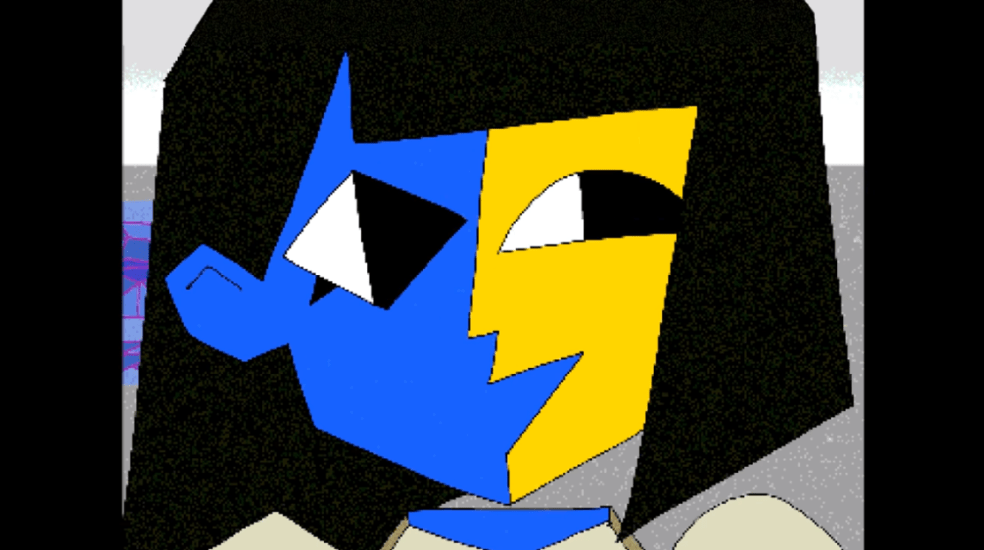
Generally I like to start my writeups by describing something’s premise. That’s not really possible with Ena, which takes place in a world so far removed from our own that things like basic narrative cause and effect aren’t really a given. But to make an honest attempt anyway, Ena is essentially the adventures of the title character, a blue and yellow….human? Probably? Who looks like she stepped out of a Picasso painting and suffers from wild mood swings. Accompanying Ena for parts of what might perhaps in a loose sense be called a journey is her friend Moony, who is a moon. Along the way, Ena meets a number of strange and colorful characters, and is generally subjected to random antagonistic surrealism.
Moony (left), Ena (right), and antagonistic surrealism (remainder of image).
I like to talk about imagery in cartoons, but with Ena, that’s most of what there is. The series has a wholly unique look that is quite unlike anything else I’ve ever seen. The inspirations can certainly be gleaned; 90s adventure games here, [adult swim] originals there, and so on, but the synthesis produces something that just on a basic level looks like almost nothing else out there. In addition to Joel G’s animations, the backgrounds play a huge role here. They’re mostly 3D modeled, and I am certainly not the first person to draw a comparison between Ena’s backdrops and those of infamous PS1 game The LSD Dream Emulator.
The series’ weird CGI backgrounds provide the perfect backdrop for its existential confusion.
The audio is hugely important too, with quite a lot of inventive, moody music and sampled sound effects. As far as voice acting, Ena herself has two sides, a relentlessly upbeat half with a chipper male voice and a deeply depressed female half. Most of the characters other than Ena and Moony speak in languages other than English. That Ena can understand them anyway only deepens the strange vibe of the series. (Although, if I can levy one complaint here, the “Japanese person speaking English” performance of one of said characters in the third short is pretty unnecessary. I’d probably call it the only bad part of the entire series.)
A vibe that does seem to be much of the point. It is really quite hard to say what, if anything, Ena is “about”, in the traditional way that art is usually “about something”. It’s a disjointed, bizarre, and at times unsettling experience. This isn’t to say that it’s meaningless, but it’s probably a mistake to treat Ena as some sort of puzzle to which the answer will eventually be revealed. The jumble of highly expressive body animations, weird allusions, deliberately-choppy dialogue, and so on, are all quite evocative on their own.
Rather than tell a single specific story, I think it’s more helpful to consider Ena as an exploration of states of mind and of emotion. Every human psyche is made up of countlessly many fragments, the seams between them are just more visible in Ena’s than they are for most of us. Much of the second short especially feels like a nebulous, cloudy metaphor for trying to figure yourself out.
We could easily consider the many “NPCs” Ena encounters to be as much fragments of her own mind as she herself is too, an approach that would rarely occur in more traditional media, but makes a ton of sense here. Especially with the recent revelation that there is more than one “Ena”, and with how in the second episode, the characters’ subtitles do not actually match with what they are saying.
Much of Ena’s own most zonked-out dialogue, appropriately, speaks to existential confusion. A feeling that even the most well-adjusted of us can surely relate to in these still-COVID-lockdown’d days, which I think may explain some measure of the series’ popularity. (Indeed, Ena may stand as one of the most singular artistic achievements of the pandemic period.)
There is too the relationship between minds; the friendship between Ena and Moony is the only consistent character relationship in the series, and is surprisingly complex. Moony seems to like Ena but not really understand her. This is most obvious in her failure to grok Ena’s mood swings, or how to deal with them. When Ena has an apparent panic attack in “Temptation Stairway” (the third short), a temporarily incapacitated Moony simply groans that she’s “giving her an advantage” on the impromptu bet they made, and seems to genuinely wonder why she’s acting the way she is instead of getting a move on. In the second short, one of Ena’s confused rants is mistaken by Moony for drunkenness. These things point to a friendship that is not an altogether healthy one, and it’s intriguing that this is the sole consistent relationship across all three shorts. Whether or not it will be repaired, or if Ena will grow out of it, or whatever else, remains to be seen.
In “Temptation Stairway”, among the many characters Ena meets is the curious Phindoll, a pink dolphin who emerges from what appears to be anophanim. Phindoll is the only character in any of the three shorts who directly speaks to Ena and accommodates her emotional state. It’s difficult to know what to make of this, other than that we could all stand to be a bit more like Phindoll, but in the deeply abstract world of Ena it counts as character development. As does the mild disapproval Ena gives Moony at the end of that episode. She’s learning, as we all are.
Sometimes learning makes you make this face.
But that still leaves us with the question of why this is so popular. Frankly, the only reasonable theory I’ve come up with is the aforementioned pandemic connection. But it is also just possible that abstract internet culture is “mainstream” (relatively speaking) enough now that this kind of thing just can happen and can be accepted for what it is without any need for a middle-man or a formal distributor. I think that’s a wonderful thing if it’s the case.
If you like my work, consider following me here on WordPress or on Twitter, supporting me on Ko-Fi, or checking out my other anime-related work on Anilistor for The Geek Girl Authority.
All views expressed on Magic Planet Anime are solely my own opinions and conclusions and should not be taken to reflect the opinions of any other persons, groups, or organizations. All text is owned by Magic Planet Anime. Do not duplicate without permission. All images are owned by their original copyright holders.
How the hell do you review a music video? Even as someone who really loves animated music videos, it seems impossible, and before I saw the MV accompanying Shinsei Kamattechan’s “Ruru’s Suicide Show On a Livestream” I’d have had no motivation to try. Yet, like many commentators on the arts, I have a weakness for taking wild swings at the zeitgeist. Sometimes, even if only for yourself, you come across a singular piece of art that seems to just click things into place. Seems to “get it” in a way that most do not. The “Ruru’s Suicide Show” MV premiered all the way back in early January, just eight days into what would become what is unquestionably the darkest year for the world-at-large that I have ever lived through. 2020 finally winds down in just over a month as I’m penning this, and I think I can safely say that somehow, no other anime anything this year captured the unique mixture of toxic, spiraling misery, delirious, denialistic euphoria, and the tragic endpoint of both quite like this song and this video.
All of this, I must imagine, is very much accidental. Perhaps it’s unique to me, even, and given that the video with its scant runtime of just four minutes sits atop this article, perhaps you’ve watched the whole thing and are feeling very confused as to what I’m on about. But, as I write this the video sits at over fourteen million views, far more than any other music video ever associated with a Shinsei Kamattechan song. It makes sense; the band are immensely talented and wildly creative, but they’re definitely niche despite being signed to a major label (Warner Japan, via their Unbonde sublabel). Lead vocalist Noko is an acquired taste, (I’m not even sure if that’s them on “Ruru’s Suicide Show”. It doesn’t entirely sound like them, but their voice is very flexible, so who knows.) and the band in general are no one’s idea of a shiny-polished pop group.
“Ruru’s Suicide Show” itself is the kind of song whose utility is difficult to put into words. It is based, albeit only loosely, on a very real tragedy involving a young girl named Roro that occurred some seven years ago*, which can make it seem odd, possibly even exploitative, to the uninitiated. More broadly, it taps into a long lineage of Japanese rock that I’m frankly a little unqualified to explore in-depth. (And it’s beyond the scope of this article anyway.) On a surface level, it isn’t hard to understand why a song about suicide would resonate in a particularly bleak year for the world, but I think dissecting our opening question of why specifically this requires digging a bit deeper than that.
Songs that are simply sad are one thing, “Ruru’s Suicide Show”‘s “trick”, such as it is, is relatively simple. Despite its bleak subject matter it is sonically upbeat. However, most songs like this rely on simple lyrical dissonance, the classic example over here in the US being OutKast’s “Hey Ya” (which itself is merely about heartbreak). “Ruru’s Suicide Show” goes well beyond that. Its relentlessly upbeat sound is pushed into the proverbial red, becoming first disquieting, then almost a kind of confrontational, and finally cathartic. “Ruru’s Suicide Show” is not a song for people who need a pick-me-up, it is a song one listens to so that they know that they aren’t the only person in the world who’s ever suffered like this. And whether or not “Ruru’s Suicide Show” is the sort of music that resonates with you can be correlated pretty well to whether you know what I mean when I say “like this.” It is a song for a very specific sort of person. That a major label–even an ‘indie’-focused subsidiary of one–would bankroll a video for this thing is nothing short of astounding.
And yet, there it sits. Fourteen million views and counting throughout the course of just one calendar year. Some of that popularity (like with many things nowadays) can be thanked to / blamed on TikTok, where the song caught on as something of a minor meme of all things. But while that might account for an initial spike in popularity it does not account for its continued success. And indeed if one visits the video’s comments section it is mostly people (fairly young ones, is my impression) defending the song, the video, the late Roro herself, and so on from being appropriated as a fad / fandom / meme / whatever term you care to use. These users, to whom the song clearly means as much as it does to me, demand that it, and its subject, be treated with respect.
I think some of this broad resonance may have to do with the elephant in the room. The music video itself, and how it welds to the song. Enhancing, as it does, every line with surreal, dire imagery that expertly conveys internal crisis through symbolic destruction of the outside world. And, sadly, the very literal destruction of the self.
Music videos, like other short-form projects, can be some of the “purest” animation imaginable, unbound by conventional narrative. Some months ago I compared Eureka Seven to a collage of images, but that’s often literally all music videos can afford to be, given their limited run-time. It’s no surprise then that “Ruru’s Suicide Show” is on the more surreal end as far as such things go. One can map out the broad story of the main character, but the real resonance lies in the details.
To state the obvious; the “Ruru’s Suicide Show” music video is gorgeous. Director Rabbit MACHINE has built up a body of music video and commercial work over the past decade or so, but it’s hard to imagine any of it could top this. There’s a particularly unnerving edge to the editing in this video. I imagine it’s an attempt to underscore the sharp distinction between the main character’s flights of fancy–often rendered in an even more cartoonish art style and depicting such feats as her miraculously ducking under and dodging a train–and the darker side of her psyche, including the suicidal ideation itself. To me, the grimmest shot in the entire short is a first-person aside where the “camera” is tossed into the path of a speeding train, presumably the Chuō Line mentioned in the lyrics.
Elsewhere; our protagonist laughs, lugs her stuffed rabbit around an unfriendly city, stands alone in a classroom, at one point in front of chalk drawings of butterfly wings and at another as the world outside explodes, is lost among a forest of nooses, envisions a rose blooming from her corpse, poses atop an ocean of (what else?) power lines, and pictures herself crawling into a coffin. She speaks of being bullied, of “building a gravestone” for herself on-camera. Finally, she laughs again, as she jumps.
Despite many of the details matching to the real tragedy alluded to in the song’s title, I don’t believe most of this is intended to be literal. Even the bleakest moments of the video are defined by a bright art style that does not lend itself to such interpretations. Our protagonist seems cast less as specifically Roro and more as an amalgamation of all who’ve taken their own life because they could see no other way out and were spurned there by the uncaring masses of the world. She wants to stop hurting, she wants to stop being lonely, she wants people to look at her. All of this is driven to its horrible endpoint.
Her look–downright stylish, if we’re being honest–might seem at odds with the core theme of the song and the video, but the same dynamic present between the music and the lyrics is repeated here. Her blonde hair, the pink smartphone taped to her face, the black lightning bolt hairclip providing a visual metaphor for the term denpa, all of it is intended to push past merely cute into a funhouse mirror reflection of getting lost in your own head. If you’re the sort who demands evidence of a mask slip, there is a literal one in the video, though only for the briefest moment.
We are clearly intended to both sympathize and empathize with the protagonist, but what happens to her is tragic, and here we have to return to the song itself again and more generally to Shinsei Kamattechan as musicians. I am admittedly a neophyte when it comes to the band’s discography, but I can tell (and have been told as much secondhand) that much of their work deals with alienation and a feeling of not belonging. Be that to some specific part of society or simply the world in general. It is an uncomfortable feeling, and one far more people have than I think many others may realize. It is no wonder so many of us want to be witches that talk to kittens, or aliens riding in a UFO. It is no wonder then again that so many of us come to eventually half-believe we really are. Checking each other, keeping each other in good spirits but away from the brink, is arguably the duty of those of us afflicted by mental illness. Because the consequences of dealing with this alienation alone, or with the toxic fake-help of bad actors, can be, as “Ruru’s Suicide Show” illustrates, tragic.
So the real power of “Ruru’s Suicide Show” is in melancholic solidarity. You are not alone, but giving in to this feeling will not end well. It’s also a plea for understanding; some of the lines spoken by the protagonist in the chorus could just as easily be said from a child to their parent, the so-simple-its-devastating “Mama please listen this isn’t a phase” foremost among them.
In this strength we find that “Ruru’s Suicide Show” is, in a peculiar way, a sort of two-way elegy. On the one hand it is a memorial to the titular Roro and many others like her. On the other; it is a prayer from those who did not make it for those who are still alive.
In my heart I am a worrywort. Any time I listen to this song I think about those people in the video’s comments, many of them obviously kids, and I hope that they’re okay. It’s naïve, but my hope is that by writing this, I am somehow doing some small portion of my part in the “duty” outlined above. To you, my limited audience, I simply want to reassure you, if you are reading this, you are still alive. For those who aren’t, the most we can do is to remember, and to eulogize.
Take care of yourself.
*The “Roro-chan Incident” as it’s come to be called is the sort of case where rumor and reality have bled together so much that it’s hard to know the truth of things. I will not deny that several times while writing this I did wonder if this song could be construed as exploitative. I have no real answer, the question of how much leeway a musician (or anyone) gets via artistic license is, as far as I am concerned, an unsettled one. Regardless, I find the song and video’s power impossible to deny.
If you like my work, consider following me here on WordPress or on Twitter, supporting me on Ko-Fi, or checking out my other anime-related work on Anilistor for The Geek Girl Authority.
All views expressed on Magic Planet Anime are solely my own opinions and conclusions and should not be taken to reflect the opinions of any other persons, groups, or organizations. All text is owned by Magic Planet Anime. Do not duplicate without permission. All images are owned by their original copyright holders.









 The Magic Planet