Magic Planet Arcade: Somewhere Above The Earth in the CICADAMATA Demo Disc

Magic Planet Arcade is a once-in-a-great-while column where I take a break from writing about cartoons to write about video games instead.


The flashing text of a bootup sequence gives way to a run-and-jump through an ominous, empty structure. Thoughts flash on-screen, whether they’re ours or someone else’s is not immediately clear.

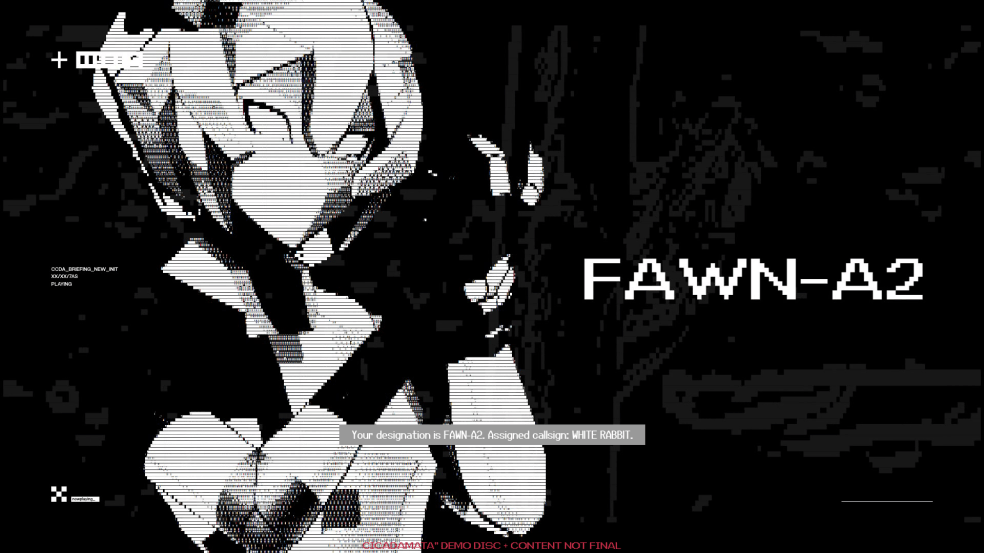
As the portentous omens come to a climax, we are reunited with our right hand, the [?handheld_assistant/;bestfriend/;gun] JOYEUSE, the first of many allcaps nouns we’re going to meet here. An AI named AEGIS, in a friendly, feminine voice, informs us that due to circumstances in our previous life, we have been drafted as a “Cicada”, broadly outlined as a sort of immortal robotic (or perhaps cyborg?) supersoldier. Our name is FAWN-A2, callsign The White Rabbit. Without more than a moment to get our bearings, AEGIS informs us that we are to be dropped into environs called SPHERES, somewhere in the CASCADE—the very nature of what the CASCADE even is is not explained to us—where we will retrieve sets of objects labeled CORES. Standing in our way is a variety of THREATS, named in broad terms that gesture at their form or function; SHOOTER, BOUNCER, CRAB, ESPER, etc., and rendered in a Superhot-esque red. Our instructions are very simple; get the CORES, get out, and if anything gets in our way, rip and tear.

If you’d think this sounds like the noun-heavy setup for a pretty simple FPS game, you’re half-right. Mechanically speaking, Cicadamata is part of the “go fast and beat ass” lineage of ‘movement shooters’ typified by something like Ultrakill. It’s an imperfect comparison, as Cicadamata‘s level layouts are generally a bit less enemy-focused and the visual aesthetic is very different (a future-retro “vectorheart” art style vs. Ultrakill‘s neo-Playstationy look), but they’re in the same ballpark. Cicadamata‘s weapon selection is very stripped-down compared to most FPSes. There is no “selection” at all, in fact. You have just one gun, Joyeuse itself, who functions as a cross between a shotgun, and, when the aim button is held, a sniper rifle. Joyeuse at your side, you can jump up to three consecutive times and dash once (thus really earning the “rabbit” part of your name) to hop about the levels, obliterate THREATS, and get to the exit. You also have a “stomp”, a diving downward drop that lets you step on enemies Mushroom Kingdom-style, should that be your preference.

Describing it in text does not really do justice to the kinetic feeling of actually playing Cicadamata. I’ve played a number of other games in this genre, and, to reveal my hand a bit, I tend to only get so much out of them. I’m simply not a competitive, top-of-the-leaderboards kind of player, it’s not in my nature. But Cicadamata‘s relatively stripped-down visual style—not a lot of complex textures here, for instance—lets it throw a lot of individual elements at you at once, which, combined with the twitchy movement and disassembled, surreal level geometry, makes the whole thing feel overstimulating in a good way. It’s properly buzzy, in fact, and AEGIS’ robotically gentle voice telling you that she’s proud of you when clear a level gives the entire thing a decidedly praise kink-y undertone. (Not the lone example of horniness. More overt, for instance, is the fact that one sees White Rabbit’s ass on the level results screen. But if you are expecting me to list that as a negative, I have bad news for you.) I am not normally the sort of person who’s inclined to try for S-rank clear times or the like, but Cicadamata tracks that, and I found myself aiming for Diamond (its highest rank) more than once, playing levels over and over despite the Demo Disc only having five of them. “Addicting” as an adjective in a video game context is beaten to death, and has a bit of a sinister cast to it. So I’ll just say I really, really enjoyed the 3 1/2 hours I managed to squeeze out of the demo, and plan to pick the game up when it releases.

Even more compelling to me than the gameplay however is the impressive amount of intrigue Cicadamata manages to build about its world in the demo’s short runtime (my first complete playthrough took perhaps 30 minutes) and lack of anything akin to cutscenes, normal dialogue, etc. If you linger around the dropship that starts each level, you’ll sometimes hear AEGIS deliver a bit of exposition about the SPHERE you’re in. (She’ll also encourage you to use the affirmation phrase “I am okay, the air is just heavy today” if you get scared or nervous. There is absolutely no sinister undertone to this whatsoever, I am assured.) There are also text terminals one can find in a few levels, something that greatly excited me in general.

Earlier, I compared this game to Ultrakill, perhaps the most successful of the movement-shooters that Cicadamata positions itself alongside. I love Ultrakill, don’t get me wrong—I’m transgender, it’s in the signup forms—but Ultrakill‘s religious saga about blood-fueled robots in an eschatological post-armageddon is a fairly different vibe than what’s going on here. To me, the text terminals seal the less immediately obvious, but perhaps more instructive, comparison. Despite having less in common with Cicadamata on a gamefeel level, the spectre of the original Marathon trilogy looms large over this game. (And the art direction brings to mind some trace of the Marathon reboot, as well.) Not just the first game, Marathon itself, but also Durandal, and Infinity. Cicadamta‘s story, if the Demo Disc is any indication, will be told in sputtering, half-remembered fragments, sometimes from the text terminals, and sometimes from stranger sources, be they hidden or randomly triggered. This very appropriate for themes of trauma, transformation, and the inherent fallibility of perception, all of which are present in the five terminals scattered across the demo. Each of these is brief, but they’re incredibly evocative, making use of cryptic phrasing, unknowable imaginary technical jargon crammed into crucial reports we have only some of the context for, diary-esque framing, and a [?bracketed word/synonym/evocative_third_word] writing trick that I’ve seen in a few places before but which never fails to delight me.

That you have to actually keep an eye out for the terminals might seem to scuttle the Marathon comparison a bit. After all, those games had plenty of hidden terminals, but most were right out in the open. But it brings most to mind a specific stretch of the series in particular, the so-called “Dream” levels in Marathon Infinity; the transitional “Electric Sheep” levels, “Where Are Monsters in Dreams“, “Eat The Path“, some of the most striking and surreal spaces in the entire trilogy, where the games’ otherwise linear storytelling begins to break down and it is made obvious to us, via heaps of surreal textual scenes, that our own player character is not necessarily an objective witness to events. Cicadamata even seems to be cognizant of this similarity, the first hidden terminal you can find makes mention of “Onaeire”, a name used vaguely but seemingly in reference to the location of the SPHERES or perhaps the entire setting in general. “Onaeire” is a fictional place-name, whatever its significance, but it seems to deliberately call to mind the adjective oneiric. Dream-like.

The Marathon comparison exists on an even more obvious level as well. Our [?shotgun/;handheld_assistant/;bestfriend] Joyeuse is named after one of Charlamagne’s swords. This is a naming convention directly borrowed from Bungie, who named the main AI companion in their first sci fi FPS trilogy Durandal and the same in the second Cortana. (Now, the one actually talking to us in our mission briefings and such is AEGIS, but given the tutorial, and some other factors, such as the talk that Joyeuse gives you little one-liner pep talks any time you zoom in with it, I do think the homage is intentional.) So this is clearly a reference Cicadamata is deliberately invoking, something being reached for.

Note Joyeuse talking to us in the bottom right. They have dozens of these quotes, some of which are just cute references and some of which seem to actively develop the relationship between Joyeuse and FAWN-A2. It’s very easy to completely gloss over this if you’re not looking for it, but I hope it remains and is expanded upon in the full game.

This would be meaningless if it weren’t a great game in its own right, of course. I do hope I made the fact that I think it very much is clear farther up this page. In addition to all that can be said about how the game looks and feels, what themes its story might eventually unpack, the main thing that impresses me is just how fresh it feels. The familiar toolbox of the movement shooter is there, to be certain, but gameplay, art, story, even audio intersecting in such a specifically compelling package makes for a game that is just absolute catnip to me and people like me. Not for nothing has the demo alone attracted a fair bit of attention (I’m not the first person to write about it, and I certainly won’t be the last). If I can peg all of its success on one thing, it is that sense of newness. Aspects of Cicadamata may be familiar, but it’s hard to name anything that’s put them together in this way before. There’s something new brewing here, and that’s genuinely exciting.

The only bad thing about all this is that, as of the time of this writing, you can’t actually play the demo anymore! I’m not really a games journalist, as the existence of just two other articles on this site about video games attests to. And by the time I’d heard about Cicadamata, played the demo, and had the thought to write about it, the timelocked demo was already just a half-day out from expiring, and by the time you read this, it will have run out entirely. (If I can levy any real criticism here it’s that I find that entire practice frustrating, though even there, I’m not sure if it’s a choice of the developers’ or some kind of requirement for being involved in Steam NextFest.) So if any of this sounds interesting to you, you will have to wait until the release of the game proper. Waiting can be frustrating, for sure, especially for something that doesn’t have a concrete release date yet. But you won’t wait alone; something else also waits in the heavens, and that, precisely, is why Cicadamata is so interesting.


Like what you’re reading? Consider following Magic Planet Anime to get notified when new articles go live. If you’d like to talk to other Magic Planet Anime readers, consider joining my Discord server! Also consider following me on AnilistBlueSky, or Tumblr and supporting me on Ko-Fi. If you want to read more of my work, consider heading over to the Directory to browse by category.

All views expressed on Magic Planet Anime are solely my own opinions and conclusions and should not be taken to reflect the opinions of any other persons, groups, or organizations. All text is manually typed and edited, and no machine learning or other automatic tools are used in the creation of Magic Planet Anime articles, with the exception of a basic spellchecker. However, some articles may have additional tags placed by WordPress. All text, excepting direct quotations, is owned by Magic Planet Anime. Do not duplicate without permission. All images are owned by their original copyright holders.

MAGIC PLANET ARCADE: 2023’s Game of The Year (So Far) is a BOCCHI THE ROCK! Web Toy

Magic Planet Arcade is an occasional column where I peek into the world of gaming, and report on what has meant something to me personally over the past while.


I’m not a games critic. I am, I would say, unreasonably cranky about the state of that particular industry. Every once in a while a game comes along that I do genuinely really like; last year there was Signalis, which to be honest I probably could’ve wrung an article out of were I not in the throes of depression and already busy with a year-end list at the time. Back in late 2020, there was OMORI, the subject of, before today, the only Magic Planet Arcade column I’ve ever done.

What prompted me to bring back the label? A ludicrously simple webtoy made by the developer/artist duo of Tamani Damani and nako775, called Nijika, whose ahoge can grow infinitely. It is based on 2022 anime BOCCHI THE ROCK!, my sixth-favorite anime of last year. There is nothing even remotely complicated about this thing; you click on Nijika’s ahoge (for those of you who are perhaps new to otakudom, that’s the little fringe of hair sticking to the top of her head. Generally seen as the sign of a foolish or dim-witted character, although not necessarily always). Clicking causes the ahoge to duplicate. You can drag the detached ahoge around the screen, shoving them into a (previously empty?) Doritos bag, for example. Do this enough, and the bag will fill up and you can feed it to a hungry Ryou. Bocchi herself appears only in her “small, depressed octopus creature” form and can be bounced around the screen by colliding her with another object, should you wish to abuse poor Bocchi and increase her already-significant suffering. All the while, Nijika herself looks around the surreal void she and the others find themselves in. Sometimes she looks at you. At no point is she impressed.

There are a few other things you can do with various combinations of the game’s elements, but honestly, not terribly many. That’s fine, this is a dumb web toy that a couple of friends knocked out in, I imagine, a course of only a few weeks at most. It’s not that deep.

But that’s precisely what makes it a fun little diversion. I am of the belief that anything that can get your mind off your troubles for a few minutes is worth something, and there is a kind of dead-simple brilliance to the whole thing. It reminds me pretty strongly of Cartoon Network’s mid-2000s run of web games, and those could honestly be pretty brilliant too. (The Courage the Cowardly Dog pyramid game is both shockingly solid and an early example of the whole “trapformer” genre.) So, for that small joy, and as a nostalgic throwback to simpler times, I am just happy Nijika’s Ahoge exists. Hopefully you are, too.


Like what you’re reading? Consider following Magic Planet Anime to get notified when new articles go live. If you’d like to talk to other Magic Planet Anime readers, consider joining my Discord server! Also consider following me on TwitterMastodonCohostAnilist, or Tumblr and supporting me on Ko-Fi or Patreon. If you want to read more of my work, consider heading over to the Directory to browse by category.

All views expressed on Magic Planet Anime are solely my own opinions and conclusions and should not be taken to reflect the opinions of any other persons, groups, or organizations. All text, excepting direct quotations, is owned by Magic Planet Anime. Do not duplicate without permission. All images are owned by their original copyright holders.

Magic Planet Arcade: Beyond The White Void in OMORI

This review contains spoilers for the reviewed material. This is your only warning.


“Waiting for something to happen?”

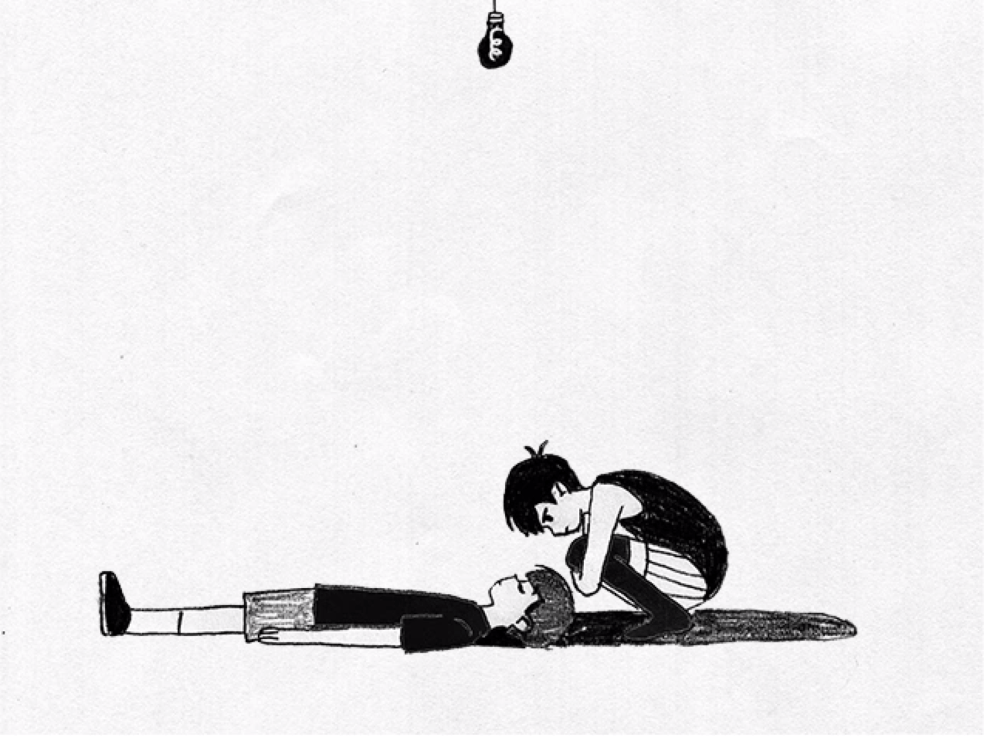
By my count, it’s been about five years since a game last made me feel bad. Not frustrated at some mechanical thing, not disappointed with it in some way, bad. As though I’d done something wrong. Today, long-in-development indie RPG Omori made me sad because some sunflowers withered and died. Surely, that alone must count for something. Undertale had to make me kill a kindly goat-man king to do that.

Which is not to say that the two are entirely dissimilar. They will definitely be brought up in the same conversations, at least. Both have some shared DNA via EarthBound, the grandfather of almost all weird arty RPGs and consequently, the one to whom all are eventually compared. But Omori comes from a different branch of that family tree. It is significantly darker, more psychological, and is in some respects more surreal. It’s also a lot less meta, which works well for this sort of thing.

If Omori reminds me strongly of any game in this particular field, it’s actually Yume Nikki. Sixteen years after it was first released, still very little is like Yume Nikki aside from its legion of mostly-unsung* fan sequels (and the criminally underrated Anodyne series), so I must emphasize that I mean this point of reference in only the best and most flattering way possible. To wit; both games star a shut-in with a knife obsession who spends their days dreaming away. Omori‘s main modification to the formula–aside from a serious expansion of scope–is that it defogs Yume Nikki‘s ambiguous nature. The boundary between the real world and the dream world is used to build a thematically complex narrative about loss, guilt and how we deal with, or fail to deal with, these feelings. Oh yeah, and mechanically, it’s an actual RPG. With, you know, enemies, status effects, treasure, secret boss fights, and things like that. Whether this is an improvement, a downgrade, or a lateral move will depend on how much tolerance you have for more-or-less traditional turn-based JRPG-style combat. (Personally, I’m fond of it.)

Narratively; Omori is the story of the titular protagonist and three of his friends. (Headstrong and stubborn Aubrey, brash and goofy Kel, and responsible and levelheaded Hero. Plus Omori’s sister, Mari, who minds the picnic baskets that make up the game’s checkpoint system.) After a relatively short prologue, their gardening photographer friend Basil goes missing, and the remainder of the game ostensibly revolves around a quest to find him. As things progress however, it quickly becomes apparent that not all is as it seems. As the quartet travel, Omori himself is stalked by a black, one-eyed Something from the shadows. It seems to wordlessly taunt the cliff-faced boy, knowing something he doesn’t.

At times, the game will cut away from the whimsical dreamworld of Headspace. Here, Omori is not Omori. He is Sunny, a shut-in who will move from the hometown he’s lived in his entire life just three days after the game begins. The relationship between Headspace and the real world is not immediately apparent. Personally, I take it as a logical extension of Yume Nikki‘s dream worlds, with “real life” being the equivalent of Madotsuki’s apartment. Fittingly, the real world’s art style is more grounded (visually, “looks like EarthBound” will once again be the common descriptor here. Look, not many RPGs are set in contemporary middle-American towns), and the brief “combat” sequences that take place here replace JRPG convention with blunt realism. Kids wale on each other ineffectually and the one time Sunny whips a knife out, things get serious very fast.

All of the characters–including the main four–have real-world counterparts as well, drawing a fascinating contrast between their simplified Headspace selves and the more complex people they are outside of Sunny’s own imagination.

None of this is to imply that Omori on the whole is “realistic.” The emotional and thematic ideas it deals with are definitely grounded in real things, but the character writing tends toward the dramatic. Those familiar with this blog will of course know that I consider “dramatic” a neutral descriptor at worst, and I think it benefits the game much more than it could be said to hurt it. Omori is capable of hitting surprisingly hard, often in ways and at times that one might not initially expect.

Even more than the main story itself (which contains more than one dark twist but ends in such a way that it all completely works), I found myself connecting with the aforementioned Aubrey. I’ve never dyed my hair bright pink and started carrying around a nail-ridden bat, but I was drawn to her attempt to escape trauma through radical self-reinvention. Similarly engrossing character writing details exist for the whole main cast. Omori may well be one of those works in which what character you identify the most with can tell you a bit about yourself.

This does lead to a bit of an odd paradox though. This praise mostly applies to the real world areas of Omori. But by and large, we spend most of our time in the game in Headspace. The writing in the Headspace sections is also good, but decidedly more fanciful. What prevents this from being a downside is that the Headspace portion of the game is also streaked with dark, unsettling shocks of horror. Omori follows a classic RPGMaker-school design rule; follow silly and lighthearted areas with deadly serious and ominous ones. For the most part, it works very well. What Headspace lacks in the emotional immediacy of the real world segments it makes up for in pastel dreams of flexing planetoids, heartbroken space pirates, ladders that reach into the sky, deserts of brown sugar, and nightmares of ghost trains, haunted forests, fog-drenched docks, and crumbling secret libraries. There is the very occasional moment where the game will try slightly too hard to be edgy, but it is truly occasional. I counted perhaps two or three such instances across my entire 20-odd hour playthrough.

And indeed the lingering discourse about Omori will, I suspect, come down to whether or not the game “earns” the right to dive into the heavy themes it does. I’ve been cagey about directly mentioning concrete plot details over the course of this review because, well, it’s a recent release and I want to encourage people to play it. But without getting into specifics, I will say that I think Omori‘s central question is essentially “what does one do when they’ve done something horrible?” It offers no single answer–multiple endings are another RPGMaker design tradition Omori adheres to–but it does pretty clearly flag what is already being called its “good ending” as being the best, and I happen to agree. That it so deeply explores its main character’s internal psyche helps a lot. There’s even a surprisingly fleshed-out segment in the game’s final quarter that flips Omori from a surreal RPG into a straight up ambient exploration game, making its Yume Nikki heritage all the more apparent in a way that meaningfully expands upon that legacy.

To lay it plain, Omori is a resounding success at almost everything it sets out to do. Its few flaws are those of circumstance or ambition and mostly boil down to nitpicks or what-ifs. (I will confess that while I don’t think the game is worse for not being this way, something like this could always be improved by being a little queerer. Then again, I am biased.) The entire thing is an astounding artistic triumph for the OMOCAT team. It can’t rightly be called a comeback (they’ve never really gone away) but it’s certainly proof that their cross-Pacific visual style can carry some real substance. Not a bad showing for an aesthetic once meaninglessly caricatured as “Touhou but fucked up“.

So let it be known; in the final days of 2020, a long-delayed indie RPG slid under the wire to become perhaps the best game of the year. Of every video game that released in 2020 that I played, it was this one that I am almost certain will stick with me the longest. I also would not be surprised if, like Kikiyama and Toby Fox’s own masterpieces, it ends up gaining a sizable cult following. Stories about the dark depths of the human mind; what drives us there, and how we might finally get out, will never stop being resonant. Even now, a whole generation of oddball teens may be discovering Omori as their first exposure to this genre. And as someone for whom strange indie RPGs were a formative experience, I cannot help but find that wonderful.


*If you’ve never delved into the world of Yume Nikki fan-sequels I highly recommend it. Parts of Omori remind me of YN itself, of .flow, of the more sinister parts of Yume 2kki, and even of the sadly largely-forgotten Misirere and LCD DEM.


If you like my work, consider following me here on WordPress or on Twitter, supporting me on Ko-Fi, or checking out my other anime-related work on Anilist or for The Geek Girl Authority.

All views expressed on Magic Planet Anime are solely my own opinions and conclusions and should not be taken to reflect the opinions of any other persons, groups, or organizations. All text is owned by Magic Planet Anime. Do not duplicate without permission. All images are owned by their original copyright holders.