
The Frontline Report is a weekly column where I summarize my journey through anime, manga, and the related spheres of popular culture over the past week. Expect spoilers for covered material.
Hello folks. Quick programming note before we get started here: Frontline Report is going to be a Mondays column from now on, since it fits a bit better with my schedule. This week’s column is, we’ll say, medium length? And primarily about Rumble Garanndoll. Listen; some weeks you don’t choose the anime, the anime chooses you.
Hope you’re all doing well out there, anime fans.
Rumble Garanndoll
Most anime that suffer from the problems that Rumble Garanndoll did a few weeks back are not helped by introducing more characters. Especially not if they’re also girls with some amount of tease-y maybe-chemistry with the male lead. Yet, doing just that has put the series back on track, and its past two episodes are probably the most interesting the show has ever been. If nothing else, Rumble Garanndoll thus continues to defy expectations.
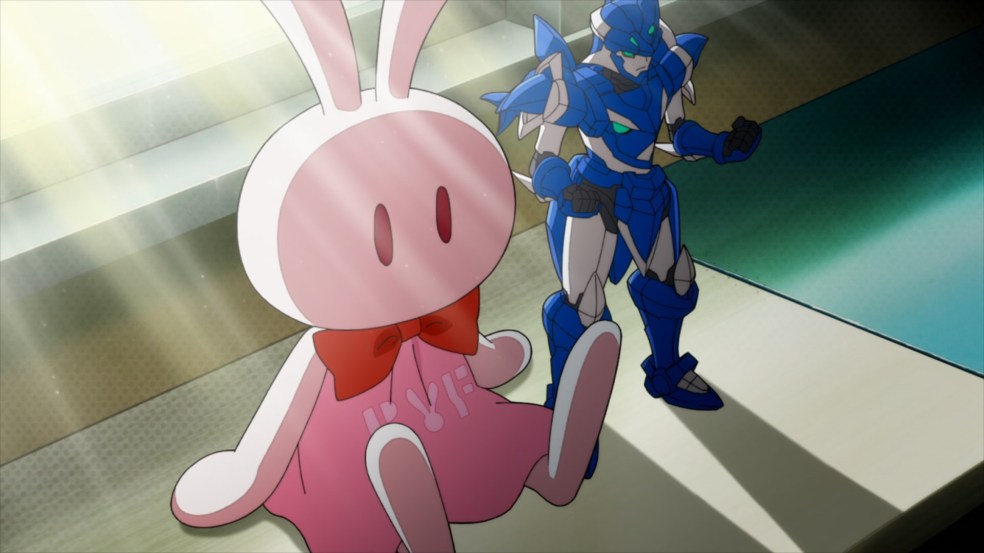
Last week’s episode, its fifth, concluded the miniature story arc of Yuki Aoba. Second-introduced battery girl, and quite possibly Japan’s last surviving idol singer. The natural self-doubt that comes with being an entertainer is compounded by the wildly difficult circumstances of Garanndoll’s setting, and so Hosomichi’s task is to get her back on track when she briefly gives the idol life up. It would be easy to do this by appealing to her imagined responsibility to her fans, or to simple nostalgia for better times, and Hosomichi does in fact try both. What eventually wins her over though is the fact that Yuki as an idol is how she’s happiest with herself, anyone else be damned. Her fans love her because she is a flawed, human person, not because of the artifice. This being Garanndoll, all of this climaxes with Yuki’s own version of the reconfigurable titular mecha–the Rabbit Two–blasting a True Army general to the ground with a rabbit-shaped beam made out of pure Idol Energy. As always, Rumble Garanndoll is at its best when it’s being least subtle.
And speaking of that, the show’s sixth episode is….well, it certainly is something.
I’ve previously commended Garanndoll for its general worldview as one of the show’s strengths. But if one ever thought that it was holding back, today’s episode tosses all subtlety to the window. This is very much a “backstory” episode, and an interlude between the series’ more bombastic moments. But in between usual interstitial fare like fun character interactions (and here, a harem series dynamic that only just manages to stay on the right side of the endearingly cheesy / annoyingly irritating divide), we get Rumble Garanndoll’s take on Japanese Nationalism.
Yes, you read that right.
It will shock no one who’s been following the series that it’s not a worldview the show holds in high regard. But even I was rather surprised at how blunt this sequence is. The conceit here is that one of the resistance’s members has smuggled in a propaganda film from the so-called True Country. There’s been some indication that they were from another world / another timeline / something like that. What’s made clear here, as the black-and-white war reel opens with a declaration that it was made in Year 90 of the “Eternal Showa Era,” is that this other world is one where Japan (and by implication, their allies as well) won World War II. Quite literally, the Japan of Rumble Garanndoll has been invaded by its own fascistic past. If that’s not quite condemnatory enough, here is what resistance commander Balzac says, word for word from the English sub track.


And coming in for the final blow is this interjection from Hosomichi’s “boss,” probably the most morally questionable character on the protagonists’ side of the show.

He perhaps has a talent for understatement.
The propaganda video itself is all monochrome authoritarian bluster. Captain Akatsuki Shinonome, our running background antagonist, decries the people of Garanndoll’s Japan–the declared “Illusory Country,” a heavy-handed erasure of the worth of millions of people–as failures with a “loser mentality.” If the show’s drawn lines from otaku culture to antifascist resistance have ever seemed silly (and I wouldn’t blame anyone for thinking they were), it’s worth noting that the rhetoric here is rooted in real examples. Moral panics about pop media permeate conservative regimes on both sides of the Pacific.
The propaganda film itself is eerily well-done, too. All monochrome except, of course, for the politically-charged imagery of blazing pink sakura blossoms.


Lest you think I’m giving the show too much credit for the “obvious” stance of being pro-democracy and freedom and anti-authoritarianist and censorship, I would point out that it is vanishingly rare for any country’s popular media to engage in such an openly condemnatory way with the dark parts of its own past. Nor does being “obvious” detract from its relevance and importance in a period of time where fascist talking points are increasingly resurfacing worldwide.
All this in the same episode that has a rather silly and drawn-out bath scene. What can I say? The show contains multitudes.
Mieruko-chan
In its more comedic moments, Mieruko-chan can struggle somewhat to justify its own existence as an adaption. At most things that make the series what it is; the creeping tension cut with enough comedy to keep it from being overwhelming, the manga is simply the better option. What Mieruko-chan the anime does offer though, if episode six is any indication, is a real treat on the rare occasions when the supernatural is helping Miko, in as much as it ever does.
The “Shrine Gods” chapter is adapted here, and it’s easily the standout sequence of the series so far. Miko bears witness to a pair–and then a trio–of shrine deities exorcising one of the most frightening phantoms she’s yet encountered. All while Hana remains naïve to the entire affair; fiddling with her phone camera and talking about Instagram while what’s essentially a horror’d up version of a shonen fight scene happens mere feet away. It’s funny, sure, but in moments like this Mieruko-chan feels like it’s exploring something a bit more worthwhile than the more disposable episodes of the anime adaption so far. Let’s hope it keeps that up.
Manga
Spy X Family
Wow, I know! A manga entry in a week where I’m not doing an actual manga shelf column. There’s a reason for that, though. I don’t have a ton to say about Spy x Family. I think it’s cute, charming, and funny. I picked it up again (after something of a false start a year or two ago) because I was interested in checking out the upcoming anime adaption. I can definitely see where enhancements and changes might be made, in particular with regard to Anya’s very good habit of looking incredibly smug. (And of course, I am very eager to see the beautiful Lor in animated form. 😊) Other than that? Everything you’ve heard about this one is true, I recommend checking it out if you have a chance.
Wanna talk to other Magic Planet Anime readers? Consider joining my Discord server! Also consider following me on Twitter and supporting me on Ko-Fi or Patreon. If you want to read more of my work, consider heading over to the Directory to browse by category.
All views expressed on Magic Planet Anime are solely my own opinions and conclusions and should not be taken to reflect the opinions of any other persons, groups, or organizations. All text, excepting direct quotations, is owned by Magic Planet Anime. Do not duplicate without permission. All images are owned by their original copyright holders.
 The Magic Planet