
New Manga First Impressions is a column where I detail my thoughts, however brief or long, about the first chapter or so of a new manga.
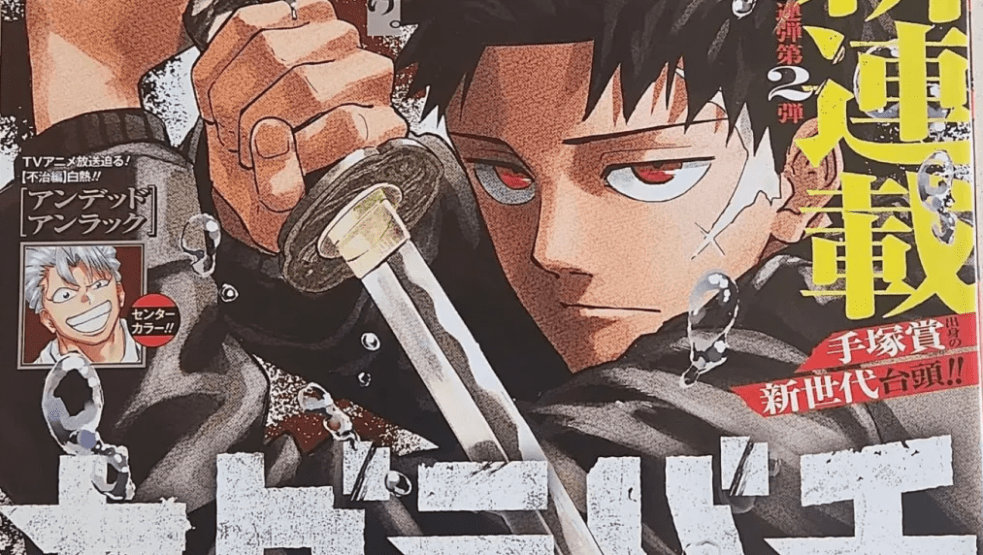
The life cycle of a meme—in the casual, internet sense of that term—is weird. Things can randomly spark some kind of cultural flame and within mere months you go from joking about, how, say, Morbius is the greatest movie of all time to it getting a second theatrical release and managing to flop twice. Simply because Shonen Jump is not as much of a presence in Anglophone pop culture as the MCU, Kagurabachi, a new title that began serializing earlier this week, is not there yet. Nor, unlike the Morbius example, is its fandom entirely ironic. But the same snowballing effect is there, if in a different way; something has a solid first chapter, maybe an exceptional one depending on your feelings on the all-sword-slashes-and-shadows school of shonen manga storytelling, and suddenly, there are lengthy copypastas calling it the greatest manga of all time, tweets about non-existent anime, game, and live-action adaptations, budget cosplays, a Discord server with some 4,000 members, and about a million jokes that all manipulate the same promo image of the protagonist drawing his sword. As of Thursday (9/21/23, for those of you reading this in the future), Shonen Jump’s English Twitter account has acknowledged the bit, so god only knows where this will eventually end.
This doesn’t need to be said, but just to get it out there; this is all pretty firmly tongue-in-cheek. I think perhaps the most telling of any of these memes that I’ve seen is the Kagurabachi bingo card, which allows for a number of standard contemporary action shonen plot beats. Plus the possibility that the series will either A) get an anime, B) flop outright, or C) get axed before either of those can happen. It also has the concession that the plot might end up being “basic.”
Nonetheless, however much or little irony any individual person making these images might have regarding their feelings for the series’ first chapter, I find it hard to believe that there isn’t something there. In comparison to its Class of ’23 contemporaries, Kagurabachi does indeed have a more immediately thrilling opening chapter than many. Time will tell if that holds up, of course—and even if it does, ongoing quality is not a guarantee of continued success. Just ask any fan of Ruri Dragon, myself included—but it’s worth at least looking at that promise, and figuring out what’s underneath all these jokes.
Kagurabachi‘s actual premise is so simple that the official summary is only a few lines long. Here it is, in its entirety:
Young Chihiro spends his days training under his famous swordsmith father. One day he hopes to become a great sword-maker himself. The goofy father and the serious son–they thought these days would last forever. But suddenly, tragedy strikes. A dark day soaked in blood. Chihiro and his blade now live only for revenge.
Kagurabachi, Manga PLUS Official Summary
True to that curt summary, what little we have of Kagurabachi so far paints it as a fairly straightforward tale of bloody revenge. There isn’t anything even remotely wrong with that of course; manga as a medium is rife with those, and some of them are very good.
We open on a bit of scene-setting, with Chihiro, as a young boy, living with his father while the latter runs a sword smithy. Chihiro’s father is eccentric, despite what one might assume from the gritty nature of his profession, and he’s introduced to us as talking with his pet goldfish. To hear him tell it, they have a lot to say.


Throughout this scene, we get little dollops of information about the world. The setting feels broadly contemporary, but Chihiro’s father’s friend, a fellow named Mr. Chiba, alludes to something called the “Seitei War” that Chihiro’s father’s swords somehow helped end. How mysterious.

For his part, Chihiro seems rather unimpressed by his old man’s reputation. In fact, as it’s nearing his fifteenth birthday it really seems like what Chihiro wants most is to follow his pa into the family business. He directly says as much, in fact, but his father is hesitant.


His father explains; swords are exemplary pieces of craftsmanship, sure. But at the end of the day, they’re weapons. Chihiro’s father believes that, whatever role they may have in ending conflict, they are also the tools used to start one, and the swordsmiths themselves are complicit in the lives lost by them. It’s a thoughtful approach. On a meta level, it’s also indicative of the many cultural differences between swords and, say, firearms, as storytelling tools. If one were to turn this guy into a dealer of almost any other kind of weapon, he’d be markedly less sympathetic than the already gray moral tone he has here.
Chihiro reassures his father that he’s willing to shoulder the burden of selling these things responsibly. Satisfied by that answer, his father brings their conversation—and this first, fairly light half of the manga—to a close by reaffirming that he believes in Chihiro.
Cue a timeskip; 38 months pass between two pages.
When we return, whatever city we’re in is not the peaceful one of the opening pages of the chapter. Wherever it may be, sword-toting yakuza rule the streets, and quash any resistance to their regime. That’s grim, if still in line with the fairly mundane world of swords and grit that the opening seemed to promise. But then, we learn that the yakuza are being bankrolled by this guy, a “sorcerer” of some description, who certainly seems to have enough magic to back that label up. In his few, gleefully villainous, pages of appearance here, he grows a black, spiky bush around a rebel’s head, leaving him to suffer until it decays on its own.


This, I think, is where Kagurabachi starts really staking out an identity. This guy’s character design alone is enough to hang a decent starter villain on, and depending on if we ever learn anything of substance about his motives, he could easily become an interesting recurring antagonist, too.
Naturally, when we next meet Chihiro he’s 3 years and change older, a fair bit taller, and a hell of a lot edgier. His face has been marked by a star-shaped scar, he’s clad in black, and toting a katana of his own. It’s honestly a little much! If you put him in tan instead of black he’d look like an Attack on Titan character. But my opinion on these things remains that it’s better to go hard on your character designs and risk overshooting than it is to play it so safe that you end up at “boring.” If there’s an artistic misstep here, it’s the former, not the latter.
Chihiro and Mr. Chiba (notably, Chihiro’s dad is nowhere to be seen) stride into the aforementioned yakuza city with, initially, plans to negotiate. Then they see a clutch of dead bodies hanging from a bridge, and at this point, the remainder of the chapter dissolves into pure action. Chihiro and Chiba can’t abide by what they’ve seen, so they bust up the yakuza controlling the city, and here, we learn just what it is that makes Chihiro’s father’s swords so special.

If you’re going to reveal that your protagonist has some kind of hidden power or technique, this is the way to do it. The sequence spans a few pages here, but it’s legitimately pretty damn cool, with Chihiro’s sword apparently possessed(?) by three inky goldfish specters which annihilate the rest of the yakuza in just a few swings.
This is not enough to pin a whole manga on, but it’s damn sure enough to pin an opening chapter on, and I think this particular trick is where Kagurabachi is getting most of its hype from right now, no matter how much ironic attachment there may or may not also be.
In general, this really is a strong first chapter, and it does a good job of providing emotional context for the burst of action that is going to be most of the reason Shonen Jump’s target audience pick this thing up. Clearly, something happened to Chihiro and his father. One does not go from a snarky but otherwise well-adjusted kid to an angel of death due to happy circumstances. Time will tell if the series can keep this momentum going, but I would say that the series’ surging popularity is, at least at this very early juncture, well-earned.
There are some weaknesses here, too, of course, very few manga absolutely nail everything right from chapter one. (The handful that do are exceptional for a reason.) The character art tends toward a bit stiff, and other than Chihiro himself and the villainous sorcerer I’d like to see the designs get a little more wild. The translation also tends toward the just slightly too-corny, with Chihiro calling the villains “slime” sticking out as a particularly bad offender. Of course, that part is not mangaka Takeru Hokazono‘s fault, and really, these are minor gripes more than serious complaints anyway. Overall, this is a very good first chapter, especially considering that it’s Hokazono’s first proper series.
At this early point, all that’s really left is to see what shape, if any, the series’ raw potential takes, not unlike the unforged swords in the chapter’s opening pages themselves. The manga’s early fan community will be a huge boon to it if it can manage to pull a good story from this setup (and if it can keep delivering on the action), and no amount of ironic distance will diminish that.
Like what you’re reading? Consider following Magic Planet Anime to get notified when new articles go live. If you’d like to talk to other Magic Planet Anime readers, consider joining my Discord server! Also consider following me on Anilist, BlueSky, or Tumblr and supporting me on Ko-Fi or Patreon. If you want to read more of my work, consider heading over to the Directory to browse by category.
All views expressed on Magic Planet Anime are solely my own opinions and conclusions and should not be taken to reflect the opinions of any other persons, groups, or organizations. All text, excepting direct quotations, is owned by Magic Planet Anime. Do not duplicate without permission. All images are owned by their original copyright holders.
 The Magic Planet


