
This article contains spoilers.
“YOU’RE ALL LIVING A LIE!”
Today we wander fairly far afield of this blog’s mission statement. For the second time in Magic Planet Anime’s history we’re taking a look at a cartoon that is not an anime or, indeed, anything that particularly resembles one. Nonetheless, the Ena series, a trio (with more quite probably on the way at some point) of web shorts by indie animator Joel G, plus a bevy of voice, 3D graphics, and music talent along for the ride, is what we’ll be looking at today. This can’t properly be called a review, as the series is most likely not finished yet. This isn’t really a do watch / don’t watch piece either–if you’re wondering about whether you should watch Ena or not, the 45 minutes or so it’ll take you to go through the three shorts are absolutely worth it.
What I am going to attempt to do here is try to explain why they are popular, because they very much are. As I write this, even the least-viewed of the shorts has a million and a half hits on Youtube. That’s no small feat for a random indie cartoon that doesn’t even have consistent episode lengths. But something about Ena has clearly grabbed part of the popular consciousness. So I think this little detour out of my usual subject matter is well warranted. (And if you really insist that I tie it into Japanese animation somehow, the first short has a fan-made Japanese dub.)
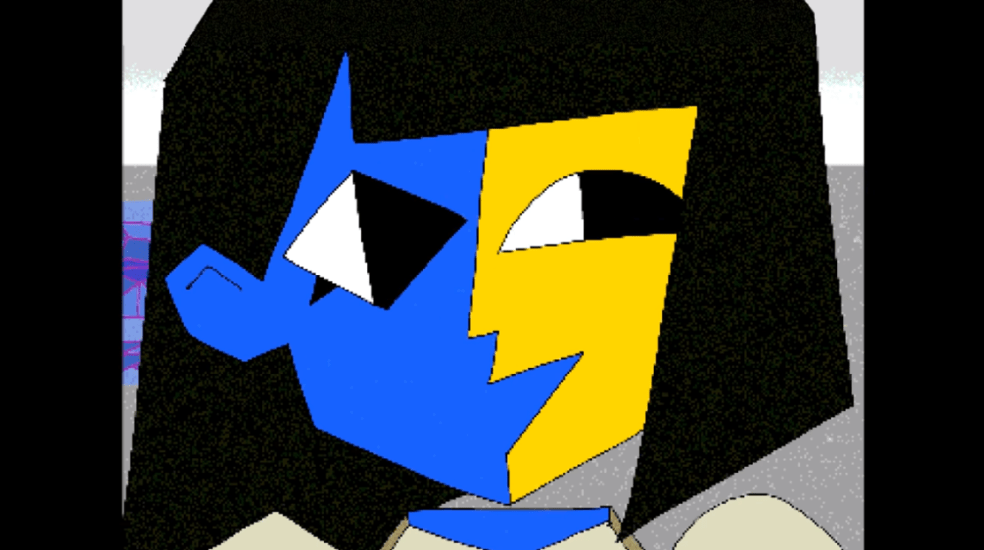
Generally I like to start my writeups by describing something’s premise. That’s not really possible with Ena, which takes place in a world so far removed from our own that things like basic narrative cause and effect aren’t really a given. But to make an honest attempt anyway, Ena is essentially the adventures of the title character, a blue and yellow….human? Probably? Who looks like she stepped out of a Picasso painting and suffers from wild mood swings. Accompanying Ena for parts of what might perhaps in a loose sense be called a journey is her friend Moony, who is a moon. Along the way, Ena meets a number of strange and colorful characters, and is generally subjected to random antagonistic surrealism.

I like to talk about imagery in cartoons, but with Ena, that’s most of what there is. The series has a wholly unique look that is quite unlike anything else I’ve ever seen. The inspirations can certainly be gleaned; 90s adventure games here, [adult swim] originals there, and so on, but the synthesis produces something that just on a basic level looks like almost nothing else out there. In addition to Joel G’s animations, the backgrounds play a huge role here. They’re mostly 3D modeled, and I am certainly not the first person to draw a comparison between Ena’s backdrops and those of infamous PS1 game The LSD Dream Emulator.

The audio is hugely important too, with quite a lot of inventive, moody music and sampled sound effects. As far as voice acting, Ena herself has two sides, a relentlessly upbeat half with a chipper male voice and a deeply depressed female half. Most of the characters other than Ena and Moony speak in languages other than English. That Ena can understand them anyway only deepens the strange vibe of the series. (Although, if I can levy one complaint here, the “Japanese person speaking English” performance of one of said characters in the third short is pretty unnecessary. I’d probably call it the only bad part of the entire series.)
A vibe that does seem to be much of the point. It is really quite hard to say what, if anything, Ena is “about”, in the traditional way that art is usually “about something”. It’s a disjointed, bizarre, and at times unsettling experience. This isn’t to say that it’s meaningless, but it’s probably a mistake to treat Ena as some sort of puzzle to which the answer will eventually be revealed. The jumble of highly expressive body animations, weird allusions, deliberately-choppy dialogue, and so on, are all quite evocative on their own.

Rather than tell a single specific story, I think it’s more helpful to consider Ena as an exploration of states of mind and of emotion. Every human psyche is made up of countlessly many fragments, the seams between them are just more visible in Ena’s than they are for most of us. Much of the second short especially feels like a nebulous, cloudy metaphor for trying to figure yourself out.
We could easily consider the many “NPCs” Ena encounters to be as much fragments of her own mind as she herself is too, an approach that would rarely occur in more traditional media, but makes a ton of sense here. Especially with the recent revelation that there is more than one “Ena”, and with how in the second episode, the characters’ subtitles do not actually match with what they are saying.

Much of Ena’s own most zonked-out dialogue, appropriately, speaks to existential confusion. A feeling that even the most well-adjusted of us can surely relate to in these still-COVID-lockdown’d days, which I think may explain some measure of the series’ popularity. (Indeed, Ena may stand as one of the most singular artistic achievements of the pandemic period.)
There is too the relationship between minds; the friendship between Ena and Moony is the only consistent character relationship in the series, and is surprisingly complex. Moony seems to like Ena but not really understand her. This is most obvious in her failure to grok Ena’s mood swings, or how to deal with them. When Ena has an apparent panic attack in “Temptation Stairway” (the third short), a temporarily incapacitated Moony simply groans that she’s “giving her an advantage” on the impromptu bet they made, and seems to genuinely wonder why she’s acting the way she is instead of getting a move on. In the second short, one of Ena’s confused rants is mistaken by Moony for drunkenness. These things point to a friendship that is not an altogether healthy one, and it’s intriguing that this is the sole consistent relationship across all three shorts. Whether or not it will be repaired, or if Ena will grow out of it, or whatever else, remains to be seen.


In “Temptation Stairway”, among the many characters Ena meets is the curious Phindoll, a pink dolphin who emerges from what appears to be an ophanim. Phindoll is the only character in any of the three shorts who directly speaks to Ena and accommodates her emotional state. It’s difficult to know what to make of this, other than that we could all stand to be a bit more like Phindoll, but in the deeply abstract world of Ena it counts as character development. As does the mild disapproval Ena gives Moony at the end of that episode. She’s learning, as we all are.

But that still leaves us with the question of why this is so popular. Frankly, the only reasonable theory I’ve come up with is the aforementioned pandemic connection. But it is also just possible that abstract internet culture is “mainstream” (relatively speaking) enough now that this kind of thing just can happen and can be accepted for what it is without any need for a middle-man or a formal distributor. I think that’s a wonderful thing if it’s the case.
Some, of course, have other theories.


If you like my work, consider following me here on WordPress or on Twitter, supporting me on Ko-Fi, or checking out my other anime-related work on Anilist or for The Geek Girl Authority.
All views expressed on Magic Planet Anime are solely my own opinions and conclusions and should not be taken to reflect the opinions of any other persons, groups, or organizations. All text is owned by Magic Planet Anime. Do not duplicate without permission. All images are owned by their original copyright holders.
 The Magic Planet