
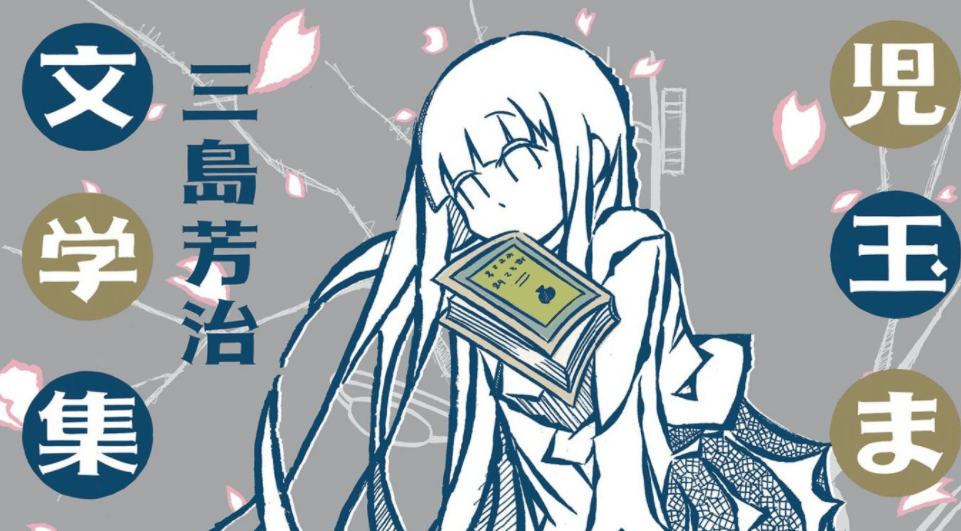
The Manga Shelf is a column where I go over whatever I’ve been reading recently in the world of manga. Ongoing or complete, good or bad. These articles contain spoilers.
There are numerous ways to start a work of fiction. You have your classics; “once upon a time”, “it was a dark and stormy night” and such that are true arch-clichés. Then, far, far on the other end of the spectrum, you have real head-scratchers. Unique opening lines that make you spit out a mental “huh?” before you even know what kind of thing you’re reading. The Maria Kodama Literary Corpus starts with one of those.
“These leaves are like Jupiter, aren’t they?” Asks the title character. Before you go flipping this particular simile over in your mind, trying to untangle it, know that that’s not really the sort of story Kodama Literary Corpus is. Corpus revolves around both Kodama herself and her male companion, our ostensible main character, Fueda. Together they make up the sole members of the school’s Literary Club, and their conversations comprise the bulk of the series. Fueda is something of a dazed everyman (although it eventually becomes clear that he’s stranger than might first be obvious), awestruck by the evident brilliance (and perhaps more obvious to us than him, the mercuriality) of Kodama. They have a fun dynamic that shines through even their more convoluted interactions. It’s cute, which is a good beating heart for any romantic comedy to have.
Of course descriptors like “romantic comedy” and “school life comedy” only loosely apply to Kodama Literary Corpus. It is perhaps more accurate to say that it uses their structure to examine topics that ordinary entries in those genres would not. In this way, it is somewhat reminiscent of Imitation Crystal’s work in the school life genre, though it’s far less emotionally dire than something like Game Club. (More distantly, it has a cousin in the more downtempo, conversational parts of Bakemonogatari.) Much of those topics consist of the structure of literature and storytelling itself, something that Kodama is keenly interested in, and is what gives the manga its name. She’s fond of blithely quipping “it’s literature.” when laying another lesson in the subject on Fueda. This is the core “storytelling loop” of Corpus, although there are other aspects to the manga as well.

The series’ somewhat flippant attitude towards fairly serious subjects (such as teenage drinking, here) in the non-Kodama/Fueda sections also pushes it further toward the IC camp of subversive pseudo-school life manga which use the format to accomplish non-traditional things.
Corpus even comes with its own dedicated “recommended reading” list, in the form of the books namechecked underneath each after-chapter doodle. This is perhaps the rare school life manga it is possible to be under-read for. (And lest it sound like I’m trying to make myself seem smart; I may well fall in that category myself. I have read just one of the books the manga mentions, and some of them I’ve never even heard of.)
The series sometimes likes to poke at its own format’s tropes as well. For example; at one point Fueda’s sister is introduced, and he takes a thoughtful lean against the fourth wall to ponder whether or not he even had a sister until a few days prior. There are also occasional shorter segments that offer looser, more surreal ideas. These are fun, although not the norm for the manga. It also picks at its romantic comedy side on occasion. One chapter establishes that Fueda can’t see very well and probably should be wearing glasses. It’s his perspective that the manga is filtered through, so the person we see as “Maria Kodama”, the long-haired school beauty, is in part his own wishful thinking, and isn’t how she actually looks in reality. Despite this, Kodama claims at one point that Fueda’s delusions “protect her”, giving away that she cares for him more than she might outwardly admit. To really nail home the point that Fueda is not purely in love with his idea of Kodama rather than the girl herself, we eventually learn that he does know what she actually looks like, and even has a picture of her reading at her desk.

Of what currently exists in English of Kodama Literary Corpus, the eleventh chapter is perhaps both its best and most representative. This chapter features a storyline wherein Fueda is asked to improve his schoolday diary. Kodama suggests he do this by thinking of the many mundane tasks he and his classmates do through a mythological, literary lens. In other words; Literary Corpus takes a chapter to analyze itself, taking a critical scalpel to its own worldbuilding and by extension those aforementioned genres. (You may notice this also means it’s basically doing my job for me, but hey, I’ve never been above an easy mark.) Fueda’s writing is greatly improved by doing this, but more importantly Kodama brings the entire thing back around to her and his relationship. She ends the chapter with another quip of “that’s literature”, and in a very real way, she’s right.
All but explicitly stated here is the idea that stories are how we connect to each other; Kodama understands that more than most, so it’s not unreasonable (or even uncharitable) to read this entire endeavor she sets upon Fueda as simply a way to bring them closer together. After all, these are the final two pages of the chapter.


The after-chapter doodle also (half-jokingly?) claims a kinship with James Joyce’s Ulysses, drawing a line between two wildly different literary traditions in a way that only an oddball underground manga could. Given the presence of both a fixation on the goings-on of daily life, and a tendency to subvert or reanalyze those expectations present in both works, it’s not really an inaccurate comparison, either. (Whether Literary Corpus is anywhere near as good as Ulysses, or indeed, vice versa, is up to you, of course.)
Not that Kodama’s intentions are all good. A few chapters after this, she slyly destroys a burgeoning poet’s interest in the form, simultaneously using Fueda as a mouthpiece to do so and doing so specifically so he doesn’t take an interest in her. It’s hard to say, the work still incomplete, whether this mildly darker undertone will be explored in detail. One could also quite easily argue given what we see that Kodama is–by intention or by side effect–saving the girl from a fairly lonely life. After all, Kodama doesn’t entirely seem to think that her own being a “literature girl” is an admirable thing, as previously established in several chapters. (And either point of view assumes this will even stick. It’s hard to say if Inoue, as the girl’s named, will return as a character in any major capacity.)
Maria Kodama Literary Corpus, all told, is a unique little thing. And really, I have no reason for writing about it here beyond that fact. Strange little underground manga like this are perhaps my favorite thing in the medium, and if I can share them with my readerbase, all the better.
Wanna talk to other Magic Planet Anime readers? Consider joining my Discord server! Also consider following me on Twitter and supporting me on Ko-Fi or Patreon. If you want to read more of my work, consider heading over to the Directory to browse by category.
All views expressed on Magic Planet Anime are solely my own opinions and conclusions and should not be taken to reflect the opinions of any other persons, groups, or organizations. All text, excepting direct quotations, is owned by Magic Planet Anime. Do not duplicate without permission. All images are owned by their original copyright holders.
 The Magic Planet