
This review contains spoilers for the reviewed material. This is your only warning.
“An arrow to end God’s tyranny.”
BACK ARROW, its name proudly and pointedly stylized in all capital letters, is a gem. Not a gem in the “hidden gem” sense where it’s a fantastic show that’s underappreciated by the masses, (although certainly some might say it is that also) but a gem in the way that you might call your quirky friend who’s a little too into conspiracy theories a gem. It’s not the best show of the Spring 2021 season, and not a personal favorite (I more respect it than anything else), but it’s among the most unique. It’s also by far the one I most expect to pick up a cult following.
On one level, BACK ARROW is a perfectly logical synthesis of the previous work of its two main creative minds; Gorou Taniguchi, creator and director of Code Geass on the one hand, and Kazuki Nakashima, scriptwriter of a number of Studio TRIGGER’s most famous work, notably Kill la Kill, on the other. The result, as anyone familiar with both of these things might guess, is a decidedly strange fusion. BACK ARROW is political, silly, grandiose, philosophical, and ridiculous. This puts it in the same broad thematic space as most of its “parent” anime, like the aforementioned Code Geass and Kill la Kill as well as some work in a similar vein (say, Symphogear). It’s not quite as good as any of those, but it manages to make a strong showing of things regardless.
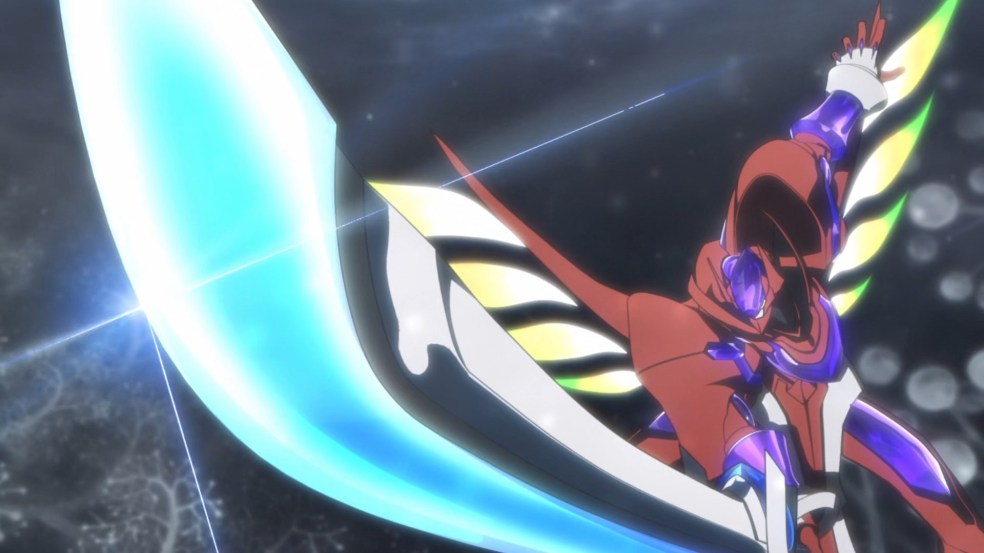
BACK ARROW concerns the geopolitics–and eventually, the cosmology–of a world known as Lingalind. It is surrounded in its entirety by a massive wall. Were it not for the presence of mecha conjured up via magic circlets called Bind Warpers, Lingalind would be a fairly typical fantasy setting for an anime. I suspect this is deliberate, as one of BACK ARROW‘s aims is to explore the logical conclusions of such a setup. There are two main nations; Rekka and Lutoh, (respectively loosely based on China and a general mish-mash of Western Europe) as well as a number of smaller powers. The mecha are powered by a force known as Conviction, and each owner of a Bind Warper has a statement that they hold as a sort of personal code which changes their mecha’s form and what it can do. (As an example, Atlee, a green-haired sheriff girl, has a conviction of “I’ll manage somehow!”)

None of this is all that complex on its own. However, when BACK ARROW‘s title character, Back Arrow (a homophonic pun name on baka ero, “perverted idiot”) arrives, Superman-style, in a capsule from the sky, things quickly change. Across twenty-four episodes, Back Arrow goes on a capital-J Journey across and eventually beyond Lingalind. Along the way, he helps dramatically reshape the world’s political landscape, and eventually comes face to face with a man named Rudolph, who claims to be “God’s arbitrator”. What this means in practice is that Rudolph–a villain so deeply goofy that at one point he drinks wine with his shoulders–plans to destroy the world.

Things go well and truly off the rails as the series enters its latter half, and if you’re the sort of person who values sheer scale above all else, BACK ARROW will be a likely anime of the year contender for you.
BACK ARROW‘s only main flaw is a sort of inarticulateness. It is fairly hard to say what the point of the series is, exactly, until its very end. Ultimately, it is the same message that almost all of Nakashima’s work imparts; no matter how great the force that holds us down, by coming together, we can overcome it. A simple message of unity in the face of any odds met that settles well with BACK ARROW‘s inherent silliness.
An acquaintance put it best, Nakashima’s main strength as a writer is “to script things that make enough sense internally even if they sound completely wild and dumb when taken out of context.” I could sit here all day and relay miniature stories of conviction particles and nested giant mecha and baby gods, but there’d be no point. These things tie together surprisingly well in the moment, but make little sense outside of them. This is the man who penned what was translated as “kick reason to the curb”, after all.

You understand by now whether or not you’d get anything out of BACK ARROW. If it is a minor work in its creators’ body thereof, that really only speaks to the strength of the competition.
I suspect in the months and years to come, those who would appreciate it will, indeed, find it. It has a magnetism to it, and like attracts like. Don’t be surprised if, five or ten years down the line, you see BACK ARROW topping a lot of “underrated anime” lists. Until then, it flies on, like an arrow in the face of an angry god.
If you like my work, consider following me on Twitter, supporting me on Ko-Fi, or checking out my other anime-related work on Anilist or for The Geek Girl Authority.
All views expressed on Magic Planet Anime are solely my own opinions and conclusions and should not be taken to reflect the opinions of any other persons, groups, or organizations. All text is owned by Magic Planet Anime. Do not duplicate without permission. All images are owned by their original copyright holders.
 The Magic Planet
Pingback: The Otakusphere: Video gaymes, bad romance and punching the heavens – In Search of Number Nine — An anime blog