
This review contains spoilers for the reviewed material. This is your only warning.
“This realm is a facility to create God.”
High-Rise Invasion is a B Movie. Specifically, despite the Netflix logo that rings in each and every episode, I remain convinced that it was pulled off of a forgotten VHS tape somewhere. If that’s not the case, it should be. Like a lot of its action-seinen brethren, High-Rise Invasion is a jumble of proper nouns, invented terminology, gamey genre tropes, and capital P Problematic scenes leveraged for shock value. For a certain kind of viewer, it’s a particular kind of fun only half in spite of all this, the sort of thing the term “guilty pleasure” was made for.
Our story starts out simply enough. Highschooler Honjo Yuri ends up in a strange world composed wholly of high-rise buildings. She must evade masked people hellbent on killing her and find her brother Rika. From these humble beginnings things quickly get complicated, and it’s only a few episodes in before Yuri has a companion (Mayuko Nise), and the show dives headlong into its lore, something it assumes you care a great deal about, on its way to its actual themes, in as much as it has them.
This has its ups and downs. Invasion‘s real weak point is its wildly inconsistent writing. As often as it decently skewers petty authoritarians and absolutists like its main villain, it lapses into rote-ness in a lot of other areas. This is particularly noticeable when it comes to the characters developing new abilities, something that happens some half a dozen times across the series’ brief twelve episodes, and never manages to rise above feeling convenient. Yuri herself, while a fun character, is not a particularly deep one. A fact underscored by her tendency to yo-yo between action heroine hyper-competence and stereotypical schoolgirl ditziness at the drop of a hat.


On the other hand, it is capable of a decent amount of resonance when it actually has something to say. Aikawa, the aforementioned main villain, is an interesting example. A wannabe fascist power-tripping over being a big fish in a small pond is a surprisingly nuanced antagonist for this sort of thing. His grandiose speeches–generally given to tiny audiences–come across as bluster and empty thunder. And while he’s definitely a serious threat, the series itself never deigns to treat his ideas seriously. Even the camera itself seems to frame him as ridiculous; none of his powers are treated with the same visual flair and coolness that the other characters’ are. It renders him absurd and cartoonish on his face.

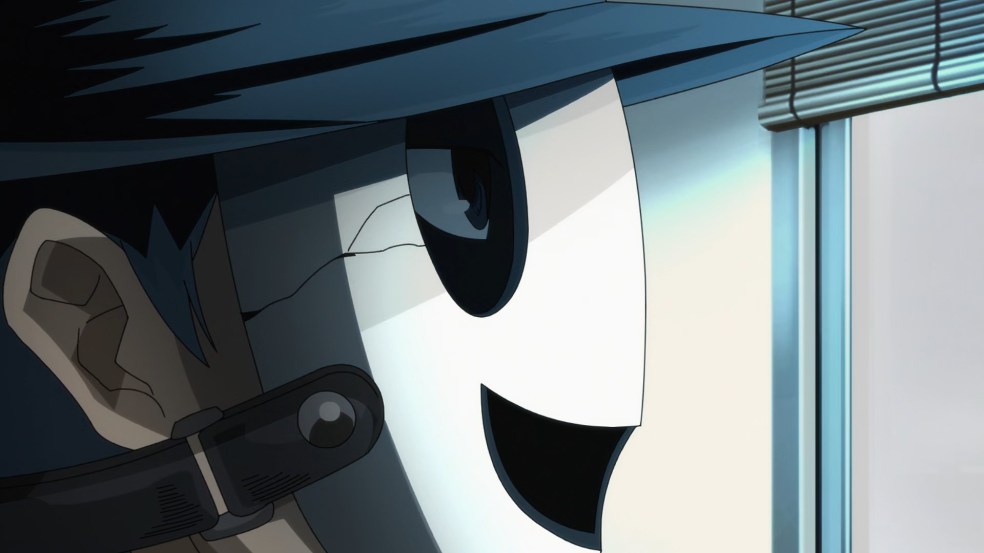
There are also a few genuinely interesting mysteries here. The nature of the “facility” that is the constructed world of the high-rises isn’t solved in the first season here, and the few encounters our characters get with the “maintenance masks” who seem to keep things running smoothly raise a lot of fun questions. These provide ample fodder for a second season, and indeed Invasion seems to have been produced with the assumption of one in mind, given that it ends on a cliffhanger.

The presentation is also solid, and there’s some cool, evocative imagery, especially toward the end of the season.

Less thoughtful is the show’s bounty of ridiculous nonsense. Whether these are a strength or a weakness will depend on the kind of viewer you are, but it’s hard to call, say, the Railgun that serves as a plot power, or Mayuko defragmenting her brain like a computer to make herself better at fighting, or the very use of the hilarious term “god candidate”, anything else. There is also the mountain of lesbian subtext between Yuri and Mayuko, which is frankly so blatant that even calling it “subtext” seems disingenuous. There’s a lot to like here, despite the often slapdash storytelling.

But, the line between the trashy but fun and the simply gross is razor thin. High-Rise Invasion spends enough time on the right side of that line that the times when it’s not stick out all the more; a scene of only-barely-thwarted sexual assault that occurs in the first episode and a truly nauseating pan over a beheaded corpse in the eleventh are easily the most egregious of these. The fanservice that kicks up and down the series is, as far as attempts to titillate go, far tamer, which makes the occasional bizarre bouts of sexual violence all the worse. It’s a shame, because with a little more care it would be pretty easy to drop a lot of the “guilty” from the “guilty pleasure” here. But, High-Rise Invasion is what it is, and it wouldn’t be right to simply wave its mistakes off.
Really, a lack of care comes to define the worse parts series in general. It approaches irony that the main villain’s philosophy is bargain-basement eugenics nonsense. High-Rise Invasion itself would be unlikely to last in any “survival of the fittest”-style trial against others in its genre for very long. Certainly the same is true for 2021 anime in general, given how strong a year for the medium it’s been and continues to be. If that second season does get made, there’s a fair amount of room for improvement, to say the least. It gives Yuri’s eventual quest to destroy the high-rise world and replace it with something kinder and better an amusing, if unintentional, meta edge.
In the end, what does one make of High-Rise Invasion? It’s hard to deny that there’s better stuff out there. (There is certainly also worse, but that’s no endorsement on its own). And I do not feel entirely comfortable writing its uglier aspects off as a consequence of its genre. Consequently, it’s certainly the sort of thing I could entirely understand someone absolutely hating. But, sometimes, a woman is really just in the mood to watch a pair of lesbians thrash through a hostile world, guns blazing and knives glinting. For those times, High-Rise Invasion hits the spot like little else, warts and all.
If you like my work, consider following me here on WordPress or on Twitter, supporting me on Ko-Fi, or checking out my other anime-related work for The Geek Girl Authority.
All views expressed on Magic Planet Anime are solely my own opinions and conclusions and should not be taken to reflect the opinions of any other persons, groups, or organizations. All text is owned by Magic Planet Anime. Do not duplicate without permission. All images are owned by their original copyright holders.
 The Magic Planet
Pingback: Seasonal First Impressions: PLATINUM END Makes Moral Bankruptcy Fun! – The Magic Planet
Pingback: (REVIEW) A Mage, a Barrel, and a BLAST OF TEMPEST – The Magic Planet