The Weird World of Joel G’s ENA

This article contains spoilers.


“YOU’RE ALL LIVING A LIE!”


Today we wander fairly far afield of this blog’s mission statement. For the second time in Magic Planet Anime’s history we’re taking a look at a cartoon that is not an anime or, indeed, anything that particularly resembles one. Nonetheless, the Ena series, a trio (with more quite probably on the way at some point) of web shorts by indie animator Joel G, plus a bevy of voice, 3D graphics, and music talent along for the ride, is what we’ll be looking at today. This can’t properly be called a review, as the series is most likely not finished yet. This isn’t really a do watch / don’t watch piece either–if you’re wondering about whether you should watch Ena or not, the 45 minutes or so it’ll take you to go through the three shorts are absolutely worth it.

What I am going to attempt to do here is try to explain why they are popular, because they very much are. As I write this, even the least-viewed of the shorts has a million and a half hits on Youtube. That’s no small feat for a random indie cartoon that doesn’t even have consistent episode lengths. But something about Ena has clearly grabbed part of the popular consciousness. So I think this little detour out of my usual subject matter is well warranted. (And if you really insist that I tie it into Japanese animation somehow, the first short has a fan-made Japanese dub.)

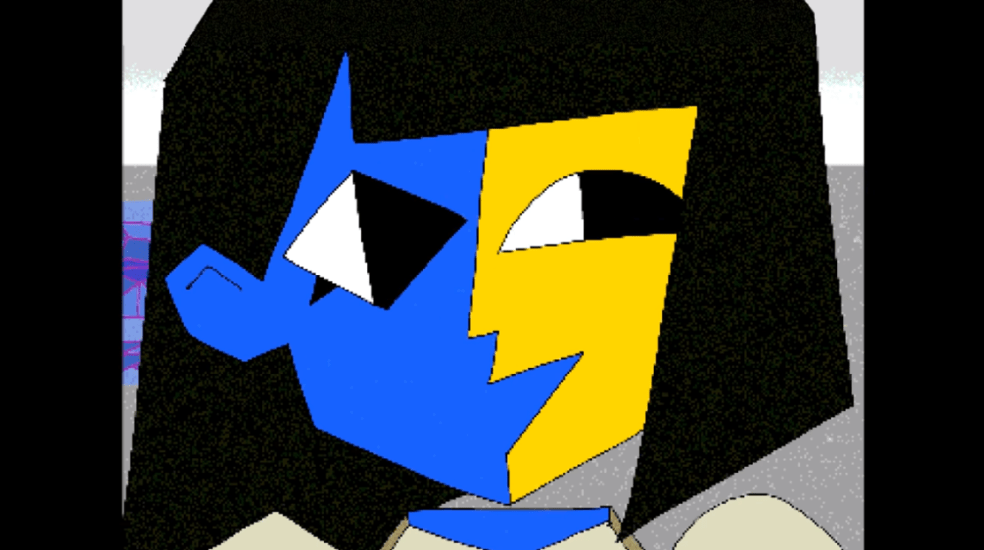
Generally I like to start my writeups by describing something’s premise. That’s not really possible with Ena, which takes place in a world so far removed from our own that things like basic narrative cause and effect aren’t really a given. But to make an honest attempt anyway, Ena is essentially the adventures of the title character, a blue and yellow….human? Probably? Who looks like she stepped out of a Picasso painting and suffers from wild mood swings. Accompanying Ena for parts of what might perhaps in a loose sense be called a journey is her friend Moony, who is a moon. Along the way, Ena meets a number of strange and colorful characters, and is generally subjected to random antagonistic surrealism.

Moony (left), Ena (right), and antagonistic surrealism (remainder of image).

I like to talk about imagery in cartoons, but with Ena, that’s most of what there is. The series has a wholly unique look that is quite unlike anything else I’ve ever seen. The inspirations can certainly be gleaned; 90s adventure games here, [adult swim] originals there, and so on, but the synthesis produces something that just on a basic level looks like almost nothing else out there. In addition to Joel G’s animations, the backgrounds play a huge role here. They’re mostly 3D modeled, and I am certainly not the first person to draw a comparison between Ena’s backdrops and those of infamous PS1 game The LSD Dream Emulator.

The series’ weird CGI backgrounds provide the perfect backdrop for its existential confusion.

The audio is hugely important too, with quite a lot of inventive, moody music and sampled sound effects. As far as voice acting, Ena herself has two sides, a relentlessly upbeat half with a chipper male voice and a deeply depressed female half. Most of the characters other than Ena and Moony speak in languages other than English. That Ena can understand them anyway only deepens the strange vibe of the series. (Although, if I can levy one complaint here, the “Japanese person speaking English” performance of one of said characters in the third short is pretty unnecessary. I’d probably call it the only bad part of the entire series.)

A vibe that does seem to be much of the point. It is really quite hard to say what, if anything, Ena is “about”, in the traditional way that art is usually “about something”. It’s a disjointed, bizarre, and at times unsettling experience. This isn’t to say that it’s meaningless, but it’s probably a mistake to treat Ena as some sort of puzzle to which the answer will eventually be revealed. The jumble of highly expressive body animations, weird allusions, deliberately-choppy dialogue, and so on, are all quite evocative on their own.

Rather than tell a single specific story, I think it’s more helpful to consider Ena as an exploration of states of mind and of emotion. Every human psyche is made up of countlessly many fragments, the seams between them are just more visible in Ena’s than they are for most of us. Much of the second short especially feels like a nebulous, cloudy metaphor for trying to figure yourself out.

We could easily consider the many “NPCs” Ena encounters to be as much fragments of her own mind as she herself is too, an approach that would rarely occur in more traditional media, but makes a ton of sense here. Especially with the recent revelation that there is more than one “Ena”, and with how in the second episode, the characters’ subtitles do not actually match with what they are saying.

Much of Ena’s own most zonked-out dialogue, appropriately, speaks to existential confusion. A feeling that even the most well-adjusted of us can surely relate to in these still-COVID-lockdown’d days, which I think may explain some measure of the series’ popularity. (Indeed, Ena may stand as one of the most singular artistic achievements of the pandemic period.)

There is too the relationship between minds; the friendship between Ena and Moony is the only consistent character relationship in the series, and is surprisingly complex. Moony seems to like Ena but not really understand her. This is most obvious in her failure to grok Ena’s mood swings, or how to deal with them. When Ena has an apparent panic attack in “Temptation Stairway” (the third short), a temporarily incapacitated Moony simply groans that she’s “giving her an advantage” on the impromptu bet they made, and seems to genuinely wonder why she’s acting the way she is instead of getting a move on. In the second short, one of Ena’s confused rants is mistaken by Moony for drunkenness. These things point to a friendship that is not an altogether healthy one, and it’s intriguing that this is the sole consistent relationship across all three shorts. Whether or not it will be repaired, or if Ena will grow out of it, or whatever else, remains to be seen.

In “Temptation Stairway”, among the many characters Ena meets is the curious Phindoll, a pink dolphin who emerges from what appears to be an ophanim. Phindoll is the only character in any of the three shorts who directly speaks to Ena and accommodates her emotional state. It’s difficult to know what to make of this, other than that we could all stand to be a bit more like Phindoll, but in the deeply abstract world of Ena it counts as character development. As does the mild disapproval Ena gives Moony at the end of that episode. She’s learning, as we all are.

Sometimes learning makes you make this face.

But that still leaves us with the question of why this is so popular. Frankly, the only reasonable theory I’ve come up with is the aforementioned pandemic connection. But it is also just possible that abstract internet culture is “mainstream” (relatively speaking) enough now that this kind of thing just can happen and can be accepted for what it is without any need for a middle-man or a formal distributor. I think that’s a wonderful thing if it’s the case.

Some, of course, have other theories.

It’s a hypothesis we can’t wholly discount.

If you like my work, consider following me here on WordPress or on Twitter, supporting me on Ko-Fi, or checking out my other anime-related work on Anilist or for The Geek Girl Authority.

All views expressed on Magic Planet Anime are solely my own opinions and conclusions and should not be taken to reflect the opinions of any other persons, groups, or organizations. All text is owned by Magic Planet Anime. Do not duplicate without permission. All images are owned by their original copyright holders.
When The Rain Breaks in WONDER EGG PRIORITY

Note: This article contains discussion of suicide and other potentially upsetting subject matter. Reader discretion is advised.


They really just don’t make many like this.

When I first wrote about Wonder Egg Priority some six weeks ago, I said that the only real potentially bad thing about its first episode was how high it had set expectations. Five episodes later, the very notion seems quaint. Among a great majority of the people watching it, Wonder Egg Priority is a frontrunner for the coveted “anime of the season” badge. For a smaller, but still significant portion, it may well be much more than that.

But just gushing about the show’s quality would largely be relating things people already know. Likewise, critics smarter than myself have pointed out that despite definitely being unique in this season, Wonder Egg Priority does have several obvious ancestors. Most notably Kuniko Ikuhara‘s work and much of what it’s subsequently influenced (your Flip Flappers-es and your Revue Starlight-ses) on one hand, and on the other, the Kyoto Animation school of stylized life dramas. These two schools of creative work together inform both Wonder Egg‘s look and feel as well as its general ethos, which I think is where much of the interesting work remains to be done on our part as viewers.

With most anime–and indeed most serial fiction–you can generally “figure it out” fairly quickly. This isn’t a bad thing, a lot of fiction gets its very power from conveying resonant messages through combinations of classic tropes. (Which are, after all, classic for a reason.) What makes Wonder Egg Priority feel distinct is that it falls into a slightly different category that I am increasingly fond of; anime that can be treated like something of a thematic puzzle box. This has vexed some of the series’ own fans. When an in-series bit of gender essentialism by the shadowy Acca went immediately unchallenged, the viewer concern was enough that the show’s staff felt the need to address it on Twitter.

That kind of commitment to “getting things right” is commendable–and very rare–but I have to admit that a small part of me was a bit disappointed that they felt the need to do so. At the risk of coming across as something of an elitist; Wonder Egg Priority demands that you engage with it critically and intelligently. While it would be unfair to say that most anime don’t assume you’ll do that, Wonder Egg seems to be inclined to much less signposting than is the norm. Things as basic as character motivation are implied instead of outright stated, and much of the series operates on symbolic logic. This can make it hard to get your head around what exactly it’s trying to do, and lest I come across as thinking I’m smarter than everyone here, I will completely cop to the very real possibility that I also don’t understand the show. But, fittingly for its halfway point, I think Wonder Egg‘s sixth episode gives us some indication of where it will go next, and what it wants to accomplish by getting there. Some indication, but not a crystal clear one.

I’m sure, for instance, that someone out there has figured This out. Not me, though.

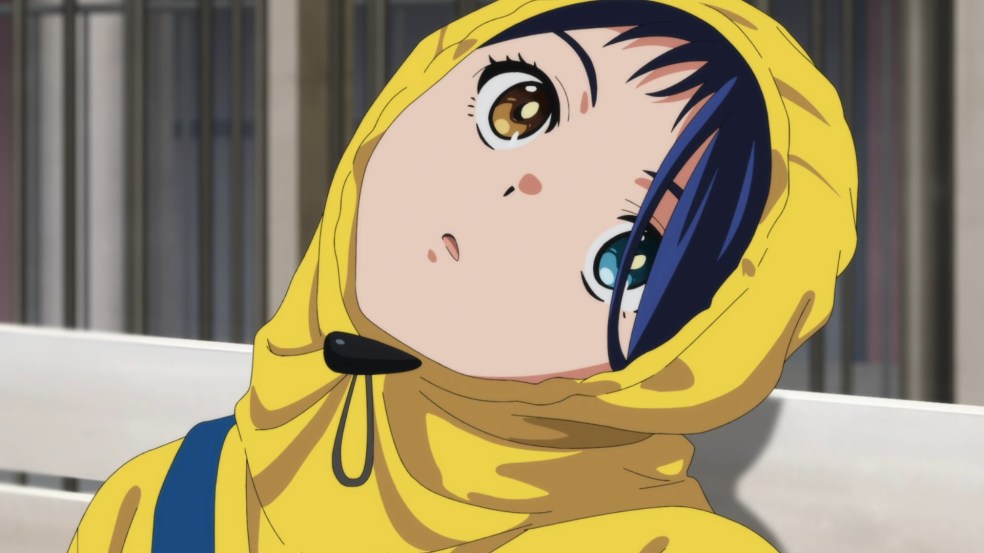
Wonder Egg Priority‘s subject matter has consistently been heavy. Suicide is baked into the series’ very premise, and its only through its absolutely wonderful visuals and sound that it avoids being a drag to watch. Along the way, abuse, familial conflict, sexual harassment, and a million other things have been dragged along for the ride. At the heart of this lies Ai Ohto, our protagonist. Her guilt over the suicide of her close friend Koito Nagase has driven much of her action throughout Wonder Egg Priority. So too has the repeated housecall visits of school teacher Shuichiro Sawaki. Sawaki is a figure it is very easy to read uncharitably.

He’s older than Ai but seems to have some kind of fixation on her, and several shots throughout the show frame him in a way that gives off a decidedly sinister air. In this very episode, he and Ai’s mother broach the subject of entering a relationship, and co-protagonist Rika openly speculates that he might be a sexual predator using that relationship to get closer to Ai. Neiru (another of the main four) meanwhile speculates that Ai’s frustrated feelings instead stem from the fact that she herself has feelings for Sawaki.

I don’t know what the “easy way out” of this particular knot of character relationships would be. What Wonder Egg puts forward is that Neiru is, if not right exactly, at least in the general ballpark. The episode, despite its sinister title, ends on a happy note, with literal clouds parting and sun shining down.

In any other series it would be quite easy to take this at face value, and that might well be what Wonder Egg is going for as well. Yet there remain lingering doubts simply due to the show’s nature, and I would not be surprised if they remain right up until the finale. For some (and I’m kind of including myself here), there will remain a suspicion, perhaps a fear, that the other shoe is about to drop, even if it never does. I’m sure, too, that others will forecast a worst-case scenario: “Oh god, they’re not going to have Ai hook up with her teacher, are they?”

I would love to refute “well no, of course they’re not. Have you seen this show? It’s too smart to do that.” And indeed, I think it’s extraordinarily unlikely. But, Wonder Egg Priority‘s very nature encourages these widely divergent readings, and I honestly think that’s part of what makes it so special.

In the opening minutes of the episode, there’s a title drop. It feels just a little tongue-in-cheek, but not so much so that it feels in any way insincere. What has me so enraptured with Wonder Egg Priority is that very sincerity. Despite its heavy themes and despite how it plays with audience expectations, nothing about it feels in any way false. Nothing feels contrived, overthought, or half-baked. It is what it wants to be. No more and no less.

What I will say, is that I tend to broadly divide all narrative art into two sweeping categories; the diagnostic and the idealistic. The former showcases and draws attention to the ills of the world. The latter presents a vision of the world as it should be. (Neither, it must be stressed, is any better than the other. Though I suspect the categories resonate more strongly with different people.) It’s usually not hard to drop an anime firmly in one bucket or the other despite many anime obviously doing at least a bit of both. With Wonder Egg Priority, I’ve been unable to place it firmly on either side. Certainly, it is keen to the problems of the world we live in, but the sheer sincerity of it all, and the weighty metaphors of eggshells and paint, seem to gesture at a brighter future.

Is this when the rain lets up, or merely a lull in the storm? Who, really, can say?

“Please let those kids find happiness.”

If you like my work, consider following me here on WordPress or on Twitter, supporting me on Ko-Fi, or checking out my other anime-related work on Anilist or for The Geek Girl Authority.

All views expressed on Magic Planet Anime are solely my own opinions and conclusions and should not be taken to reflect the opinions of any other persons, groups, or organizations. All text is owned by Magic Planet Anime. Do not duplicate without permission. All images are owned by their original copyright holders.

The Manga Shelf: Cardboard Romance in DESTROY ALL OF HUMANITY, IT CAN’T BE REGENERATED


The Manga Shelf is a column where I go over whatever I’ve been reading recently in the world of manga. Ongoing or complete, good or bad. These articles contain spoilers.


Destroy all creatures. They can’t be regenerated.
–Rules text of “Wrath of God“, and namesake of the manga.

What we have here today is, without beating around the bush, a simple boy-meets-girl romance. There are hundreds of manga like this, probably thousands, so it’s difficult for one to stand out without some kind of twist. Something that grabs the audience’s attention. That twist here is simple, but surprisingly important to the general flow of the story. As its lengthy title hints at, Destroy All of Humanity, It Can’t Be Regenerated is deeply entwined with, and is basically about, seminal trading card game Magic: The Gathering. It is, in fact, licensed, which is why the manga can get away with showing you all of its period-accurate power combos faithfully reproduced from the actual card art without having to censor them. It is frankly sensationally geeky, and it’s less a flaw and more just a fact that if you don’t have some level of MtG knowledge, the manga will be a touch hard to follow.

And yes, period-accurate. Because Destroy‘s other big deviation from the norm is that it is something of a period piece, though it’s closer to present day than the term normally implies.

The year is 1998. The global mood shifts from optimism to wariness about the impending year 2000. In Japan, Obuchi Keizō becomes Prime Minister and the Nozomi Mars probe launches. In the world of anime; Cardcaptor Sakura, Cowboy Bebop, Serial Experiments Lain and, perhaps most pertinently, Yu-Gi-Oh! all premiere. In other words; it’s not the worst time to be a nerd living in suburban Japan. Perhaps less specifically associated with Japan is the growing global popularity of Magic: The Gathering. At this point in time, Magic–and the entire medium of TCGs–was just five years old, younger than contemporary competitor Hearthstone is now in 2021. The game is about to enter one of the most infamous phases of its first decade. And it is in this environment that we meet our protagonists, and, indeed, they meet each other.

Left: Hajime. Right: Emi.

Hajime and Emi are ordinary middle schoolers*. They compete for the top spot in their grade but don’t otherwise really know each other, until one day Hajime discovers that Emi–shock of shocks–plays Magic: The Gathering, just like he does. What initially seems like it might be the setup for a very stupid “what? Girls have hobbies?!” kind of comedy eventually proves itself to be a surprisingly thorough look at both young love and the transience of youth in general. That’s a lot to put on a manga about a card game, but it’s not exactly unique in this regard, as we’ll get to.

Destroy All of Humanity‘s real ace in the hole here is an ability to transmute pop-culture ephemera into actual, meaningful pathos. Obviously, the connection to Magic: The Gathering is what runs deepest. There is an ongoing thread wherein the release of various sets–especially those in the Urza block–is directly and deliberately correlated with the basic inevitability of time moving forward. “Growing up” is a big theme here. Another occasional reference point, Revolutionary Girl Utena, is tied explicitly to the arc of a specific character, Yakumo.

It’s good to know the shadow girls are still getting work.

Elsewhere, everything from the Boogiepop series that spawned the Light Novel format to Final Fantasy VII, to Eurodance hit “What Is Love?” come up. Sometimes, as with the many anime referenced, these appear to just be namechecks, but they tie into the wider narrative often enough that the interpolations feel meaningful rather than simply clever.

So why this, why all of these allusions? Well, they’re merely the methodology. Destroy All of Humanity runs on the same internal logic as a sports movie. Personal growth is tied, directly or not, to persistence, determination, and skill at a game of choice. In that way it’s very classic, maybe even old-fashioned. What prevents it from feeling maudlin or corny is a shock of wistful melancholia that shoots through much of the series. There is a palpable sense that with the end of the 20th century comes a kind of end of innocence. Everyone, Hajime most of all, is keenly aware that teenage years don’t last forever.

Running alongside the many references to pop culture media is a lone nod to one of the phenomena of the day. A fixation on the idea that the year 2000 would bring about the end of the world–in recent memory this has largely been supplanted by the later 2012 debacle, but it was definitely a presence at the time. Here, it serves as the simplest of the manga’s many metaphors for the waning of youth. But in that would-be apocalypse, it sees a kind of romance, and it is for that reason that it’s so easy to root for Hajime and Emi. Even if the world were to burn, they’d have each other.

Tip for all the straight boys in the audience: if she asks you to “be with her when the world ends”, that means she dreams of kissing you under the moonlight.

Visually, Destroy All of Humanity‘s default mode is a sort of nostalgic charm. The character designs aren’t throwbacks exactly but they don’t quite feel contemporary either, aiming for a sort of timeless middleground that works more often than it doesn’t. The backgrounds similarly hit an ageless “suburban Japan nostalgia” feel that is so ingrained in the medium it’s practically invisible if you don’t take the time to notice it.

The main thing that departs from all this is the actual Magic duels themselves. There’s a certain type of person who will want to pick this manga up just for the wonderfully nerdy sight of things like a mill combo (specifically, the “Turbo Genius” deck, and yes, they do use that very name in-fiction here) getting the full Yu-Gi-Oh! treatment.

Destroy All of Humanity is also good at capturing how control players see themselves.

And about that whole “rival in love” thing. The main pairing remains pretty uncontested throughout, but Destroy does manage to shake things up a few times, and the duels also being the emotional centerpieces of the story is a big part of how. The aforementioned Turbo Genius duel is actually surprisingly intense. (Making a Blue artifact deck the one the “bad guy” of the match uses may be a little obvious, admittedly.) It’s not the only one of its ilk in Destroy All of Humanity, either, mangaka YOKO really seems to have a knack for this kind of thing.

In general, Destroy All of Humanity has few notable flaws. It is noticeable how often the skeevier side of 90s otakudom is simply brushed off. One minor character’s bouts of misogyny are even played as an obvious joke–no one takes him seriously–which frankly just kind of seems like wishful thinking. But this is a minor complaint and I find it hard to hold against the series.

It is also worth noting that Destroy All of Humanity isn’t finished. The series releases fairly slowly, though scanlators The Fallen Angels are diligent about translating it when new chapters do release. So there is of course, time for all of this to go south, but it seems unlikely that it will. Things aren’t this well-written by mistake.

The most recent chapter ends with the delightfully sitcom-y revelation that–oh my!–our lovebirds are in the same class after years of being assigned different classrooms within their grade.

It’s the kind of slightly-cheesy twist that suits this sort of thing well. Where is it going to take it? Who knows. But when Destroy All of Humanity finally ends, I think I do know where Hajime and Emi will be; right beside each other.


*I think. They’re called “middle-schoolers” in the scanlation but act more like high schoolers and I can’t tell if that’s artistic license or due to that thing where Japanese and American high school years don’t line up exactly right. I suppose it ultimately doesn’t matter.


If you like my work, consider following me on Twitter, supporting me on Ko-Fi, or checking out my other anime-related work on Anilist or for The Geek Girl Authority.

All views expressed on Magic Planet Anime are solely my own opinions and conclusions and should not be taken to reflect the opinions of any other persons, groups, or organizations. All text is owned by Magic Planet Anime. Do not duplicate without permission. All images are owned by their original copyright holders.